

Smoking cravings are defined as conditioned responses to internal and external cues that the brain has linked to nicotine through thousands of repetitions. These responses are not purely physical. Understanding what triggers smoking cravings means recognizing that most urges come from learned neural pathways, not just nicotine withdrawal. The average smoker takes 10–15 puffs per cigarette across 15–20 cigarettes per day, reinforcing those pathways tens of thousands of times per year. That scale of repetition is why cravings feel automatic. They are not a sign of weakness. They are the brain doing exactly what it was trained to do.
What triggers smoking cravings at their core?
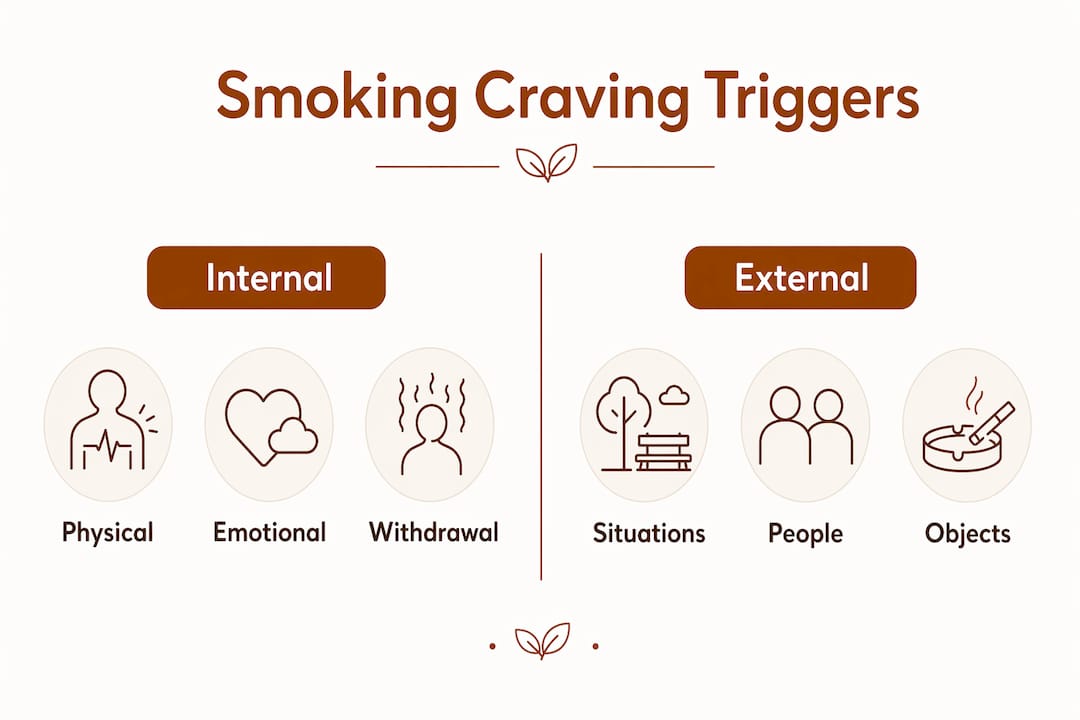
Smoking triggers fall into two categories: physical and psychological. Physical triggers come from nicotine withdrawal, the body’s reaction to dropping nicotine levels. Psychological triggers come from conditioned memories, situations, and emotions the brain has fused with smoking over time. Nicotine withdrawal causes cognitive and attention disturbances that make quitting harder than most people expect. These disturbances are temporary, but they amplify every psychological trigger you encounter.

The critical insight is that physical and psychological triggers rarely arrive separately. They overlap and intensify each other. A mild withdrawal sensation becomes an urgent emotional craving when it collides with a familiar situation. Knowing which type of trigger you are dealing with is the first step toward choosing the right response. Breathefree’s guide on nicotine cravings and coping breaks this distinction down in practical terms.
What are internal cues and how do they trigger smoking cravings?
Internal cues are feelings, emotions, and body sensations that the brain has learned to associate with smoking. They are invisible to everyone around you, which makes them harder to anticipate and manage.
The most common internal triggers include:
- Stress and anxiety. The brain learned that nicotine temporarily blunts the stress response, so stress now cues a craving automatically.
- Boredom. Smoking filled idle time for years. An empty moment now signals the brain to reach for a cigarette.
- Irritability. Mild frustration, especially during early quitting, gets amplified by withdrawal and feels like an urgent need to smoke.
- Finishing a task. Completing work, a meal, or a phone call became a reward cue tied to lighting up.
- Physical tension. Tight shoulders or a racing heart from withdrawal gets misread as an emotional need for relief.
Body tension from withdrawal is frequently misinterpreted as an emotional need for a cigarette. That misreading is what makes internal cravings feel so convincing. The sensation is real. The conclusion the brain draws from it is not.
Pro Tip: When a craving hits, pause and ask: “Is this a body sensation or an emotion?” Physical cravings tend to feel like a dull pull or restlessness. Emotional cravings feel more urgent and tied to a specific thought or situation. Naming the type gives you a moment of control before you react.
What external cues commonly trigger smoking cravings and why?
External triggers are the situations, places, people, and objects that the brain has paired with smoking through routine. High-frequency external triggers include coffee, finishing a meal, driving, work breaks, and alcohol, all linked to routines that pair nicotine intake with dopamine-producing activities. Dopamine spikes from food, coffee, and nicotine co-occur in the brain, creating strong associative learning that locks these activities together. That is why the after-dinner cigarette feels almost mandatory for many smokers.
Smokers also misattribute natural post-meal relaxation to cigarettes because the brain fuses the body’s natural parasympathetic rest state with nicotine’s dopamine spike. The relaxation was always coming. The cigarette just took the credit.
| Trigger category | Common examples | Why it fires |
|---|---|---|
| Beverages | Coffee, alcohol, tea | Paired with smoking in daily routines |
| Meals | After breakfast, lunch, dinner | Natural relaxation fused with nicotine reward |
| Locations | Car, office break room, front door | Physical spaces linked to habitual smoking |
| Social settings | Bars, parties, smoking friends | Peer behavior and shared rituals reinforce cues |
| Emotional states | Stress, boredom, celebration | Nicotine used as emotional regulation tool |
Managing external triggers falls into three categories: reduce, redesign, and face. Reduce means cutting exposure to the trigger when possible. Redesign means changing the routine so the trigger no longer leads to smoking. Face means staying in the situation and practicing a new response. Most people need all three strategies at different points in their quitting process.
- Reduce: Avoid the smoking area at work during the first weeks of quitting.
- Redesign: Switch your morning coffee to tea, or change where you drink it, to break the pairing.
- Face: Stay at the bar with friends and hold a glass of water instead of stepping outside to smoke.
How do neurological processes and muscle memory reinforce smoking cravings?
The brain builds neural pathways through repetition. Every cigarette you smoked carved that pathway a little deeper. Smoking is a neuromuscular habit reinforced hundreds of thousands of times per year, which is why the urge can feel physical even when no nicotine is left in your body. The pathway does not disappear when you quit. It goes dormant, waiting for a familiar cue to reactivate it.
Muscle memory plays a specific role that most quitting advice ignores. The hand-to-mouth action of smoking is wired into the body’s motor system. Your hand knows what to do before your conscious mind has made a decision. This is why many people who quit still reach for a cigarette during a stressful phone call weeks or months after their last smoke.
Understanding neurological changes during nicotine withdrawal helps explain why early quitting feels so disorienting. The brain is recalibrating systems that nicotine had been managing for years.
Key facts about neural pathways and muscle memory in smoking:
- Dormant pathways can be reactivated by a single familiar cue, even years after quitting.
- The hand-to-mouth ritual is a separate habit from nicotine dependence and requires its own replacement strategy.
- New pathways form through repeated new behaviors, which is why consistent substitution works over time.
- Cravings triggered by memory typically peak within 3–5 minutes and pass without action.
Pro Tip: Address the hand-to-mouth habit directly. Holding a physical object during high-risk moments, such as a pen, a stress ball, or a purpose-built tool like the Breathefree resistance necklace, gives the motor habit somewhere to go without feeding the nicotine pathway.
How can understanding triggers help manage and reduce smoking cravings?
Knowing your triggers turns a reactive problem into a predictable one. Once you can name the cue, you can plan a response before the craving arrives. This shift from reacting to planning is what separates people who manage cravings well from those who feel constantly ambushed.
A practical approach to managing smoking urges follows four steps:
- Map your triggers. For one week, write down every craving and what preceded it. Note the time, location, emotion, and activity. Patterns will emerge within days. A quitting action plan built around your specific triggers is far more effective than a generic approach.
- Categorize each trigger. Decide whether to reduce, redesign, or face each one. Not every trigger can be avoided. Some, like stress, must be faced with a new coping tool in hand.
- Substitute the ritual, not just the nicotine. Replace the behavior, not just the substance. A walk after dinner replaces the after-meal cigarette. Deep breathing replaces the stress smoke. Learning how to replace your smoking ritual with a healthy behavior is one of the most effective long-term strategies.
- Plan for social and stress triggers in advance. Decide before you walk into a bar or a stressful meeting what you will do when the urge hits. Having a plan reduces the cognitive load in the moment when willpower is lowest.
Differentiating craving types helps choose appropriate responses. A physical craving calls for distraction and time. An emotional craving calls for addressing the underlying feeling directly, whether through movement, breathing, or conversation.
Key Takeaways
Smoking cravings are conditioned responses to learned cues, and identifying whether a craving is physical, emotional, or situational is the most effective first step toward managing it.
| Point | Details |
|---|---|
| Cravings are conditioned, not random | Triggers form through thousands of repetitions linking situations to nicotine. |
| Physical and psychological triggers overlap | Withdrawal sensations amplify emotional cravings, making urges feel more urgent. |
| Muscle memory drives urges independently | The hand-to-mouth habit persists after nicotine leaves the body and needs its own replacement. |
| Three strategies cover all external triggers | Reduce, redesign, or face each trigger with a planned response ready in advance. |
| Naming the trigger type improves outcomes | Knowing whether a craving is physical or emotional helps you choose the right coping action. |
What I’ve learned about cravings that most advice gets wrong
The standard advice tells people to “avoid their triggers.” That works for about a week. Then life happens. The real skill is learning to read a craving accurately, not just dodge it.
What I have found, both personally and in watching others go through this process, is that most people treat every craving as a physical emergency. They panic. They white-knuckle it. And when the craving passes on its own in a few minutes, they are surprised. Chronic nicotine dependence blunts autonomic nervous system sensitivity, so early discomfort during quitting is the body relearning how to regulate itself. That discomfort is not a signal to smoke. It is a signal that healing is happening.
The other thing most advice misses is the muscle memory piece. People focus entirely on nicotine and ignore the ritual. Your hands have a habit. Your mouth has a habit. Those habits need a destination. Giving them one, through a physical substitute, a breathing practice, or a tactile object, is not a crutch. It is neuroscience applied practically.
Be patient with the process. The pathways that took years to build will not dissolve in a week. But every time you ride out a craving without acting on it, you weaken that pathway a little. That is not a metaphor. That is how the brain actually works.
— Tommy
Breathefree tools that work alongside your trigger awareness
Understanding your triggers is the foundation. Having the right tools makes it easier to act on that understanding every day.

Breathefree’s Nicotine Detox eBook and Habit Tracker gives you a structured way to log cravings, identify patterns, and track your progress over time. The habit tracker turns the abstract work of trigger mapping into a daily practice you can actually see. Breathefree also offers the resistance necklace, a nicotine-free physical tool that addresses the hand-to-mouth ritual directly. Over 75,000 people have used Breathefree’s method to quit. The combination of self-awareness, a clear plan, and the right physical support is what makes the difference between white-knuckling it and actually breaking free.
FAQ
What triggers sudden smoke cravings out of nowhere?
Sudden cravings are almost always triggered by a subtle cue the conscious mind did not register, such as a smell, a sound, or a passing emotion. These cues reactivate dormant neural pathways formed during years of smoking.
Why do physical sensations trigger smoking urges?
Physical sensations like tension, restlessness, or a racing heart are often withdrawal symptoms that the brain misreads as a need to smoke. The body learned to associate those sensations with relief from nicotine, so it signals a craving automatically.
How long do nicotine cravings last when quitting?
Individual cravings typically peak and pass within 3–5 minutes. The frequency of cravings decreases over weeks as neural pathways weaken without reinforcement.
Why do I crave cigarettes after eating?
The brain fuses the body’s natural post-meal relaxation response with nicotine’s dopamine effect through repeated pairing. After years of smoking after meals, the relaxation itself becomes a trigger for craving.
Does stress always cause smoking cravings?
Stress is one of the strongest internal triggers because nicotine temporarily suppresses the stress response, training the brain to crave cigarettes when stress rises. Managing stress through breathing, movement, or other physical outlets directly reduces stress-related urges.