

Deep breathing calms anxiety by shifting your autonomic nervous system away from the fight-or-flight state and toward the rest-and-digest response. The mechanism is direct: a slow, extended exhale activates the vagus nerve, which signals the heart to slow down and tells the brain that the threat has passed. This can happen quite rapidly.
A systematic review of 72 breathing interventions found that 54 of them significantly reduced stress and anxiety. A separate small experimental study (n=27) confirmed that slow breathing produces measurable EEG changes alongside reduced subjective anxiety. The science is consistent: this works.
What changes in your body almost immediately:
- Heart rate drops as vagal tone increases
- Cortisol levels begin to fall with sustained practice, according to Mayo Clinic reporting
- Heart rate variability (HRV) increases, a reliable marker of parasympathetic activity
- Muscle tension in the chest and shoulders tends to ease
Try this right now (takes under 2 minutes):
- Sit upright or lie down. Place one hand on your belly.
- Inhale slowly through your nose for 4 counts, letting your belly push your hand outward.
- Exhale through your mouth for 6 counts, letting your belly fall.
- Repeat 3–5 times without rushing.
That extended exhale is important. You are not just relaxing. You are sending a neurological signal to slow your heart rate.
Pro Tip: If your chest rises before your belly does, you are chest breathing. Belly movement first is the target. It takes a few tries to retrain, but the shift is noticeable within a single session.
Key Takeaways
Deep breathing calms anxiety by activating the vagus nerve through extended exhalation, shifting autonomic balance toward parasympathetic dominance and measurably reducing heart rate, cortisol, and amygdala reactivity within minutes.
| Point | Details |
|---|---|
| Extended exhale is the mechanism | Prolonging the exhale activates vagal pathways that slow heart rate and reduce sympathetic arousal. |
| Session length matters | Research links sessions of at least 5 minutes to significant anxiety reduction; shorter fast-only sessions rarely work. |
| 54 of 72 interventions worked | A peer-reviewed systematic review found the majority of breathing interventions significantly reduced stress or anxiety. |
| Guided training improves outcomes | Human-guided or app-guided sessions increase consistency and effectiveness, especially early in practice. |
| Micro-practices build resilience | Three-breath habits spread across the day build the automaticity that makes breathing work faster when anxiety spikes. |
Table of Contents
- Why deep breathing calms anxiety: the nervous system explained
- What the research actually shows
- Which breathing techniques actually work for anxiety
- How to calm an anxiety spike right now: a step-by-step protocol
- A research-backed 4-week practice plan
- When deep breathing may not be enough, and when to stop
- An editorial perspective on breathing as a frontline tool
- Breathefree and the habit of breathing better
- Sources
Why deep breathing calms anxiety: the nervous system explained
Your autonomic nervous system runs two competing programs. The sympathetic branch accelerates everything: heart rate, breathing rate, cortisol output, muscle tension. The parasympathetic branch does the opposite. Under anxiety, the sympathetic branch is running the show. The reason deep breathing can interrupt that is structural: breathing is one of the only autonomic functions you can also control voluntarily. That gives you a direct lever.
The vagus nerve and why the exhale matters more than the inhale
The vagus nerve is the main highway of the parasympathetic system. It runs from the brainstem down through the heart, lungs, and gut. When you exhale slowly, the lungs deflate, pressure in the chest changes, and stretch receptors in the lungs send a signal up the vagus nerve to the brainstem. The brainstem responds by slowing the heart. Harvard Health clinical guidance describes this as taking advantage of a reflex: prolonging the exhale specifically activates the vagal pathways that reduce heart rate and promote relaxation.
Inhaling does the opposite. Heart rate briefly speeds up during inhalation. That is normal and healthy. The net effect of slow, deep breathing is a rhythmic oscillation that, over several breath cycles, pulls your average heart rate down.
HRV, baroreflex sensitivity, and what they tell you
Heart rate variability measures the beat-to-beat fluctuation in your heart rate. Higher HRV generally reflects a more responsive, healthier autonomic system with stronger parasympathetic tone. Slow-paced breathing at roughly six breaths per minute synchronizes respiratory rhythms with baroreflex oscillations at approximately 0.1 Hz. This synchronization amplifies vagally mediated HRV and baroreflex sensitivity, both of which are plausibly linked to reduced perceived anxiety. In plain terms: your cardiovascular system becomes more flexible and less reactive.
CO2, oxygen, and the hyperventilation trap
Shallow, fast breathing under stress blows off too much carbon dioxide. Low CO2 causes blood vessels to constrict, reduces oxygen delivery to the brain, and triggers tingling, dizziness, and a paradoxical increase in anxiety. Slow diaphragmatic breathing restores the CO2/O2 balance. Cleveland Clinic guidance explains that diaphragmatic breathing mechanically reduces the work of breathing compared to chest breathing and helps prevent hyperventilation, which is a direct cause of anxiety escalation during stress.
What happens in the brain
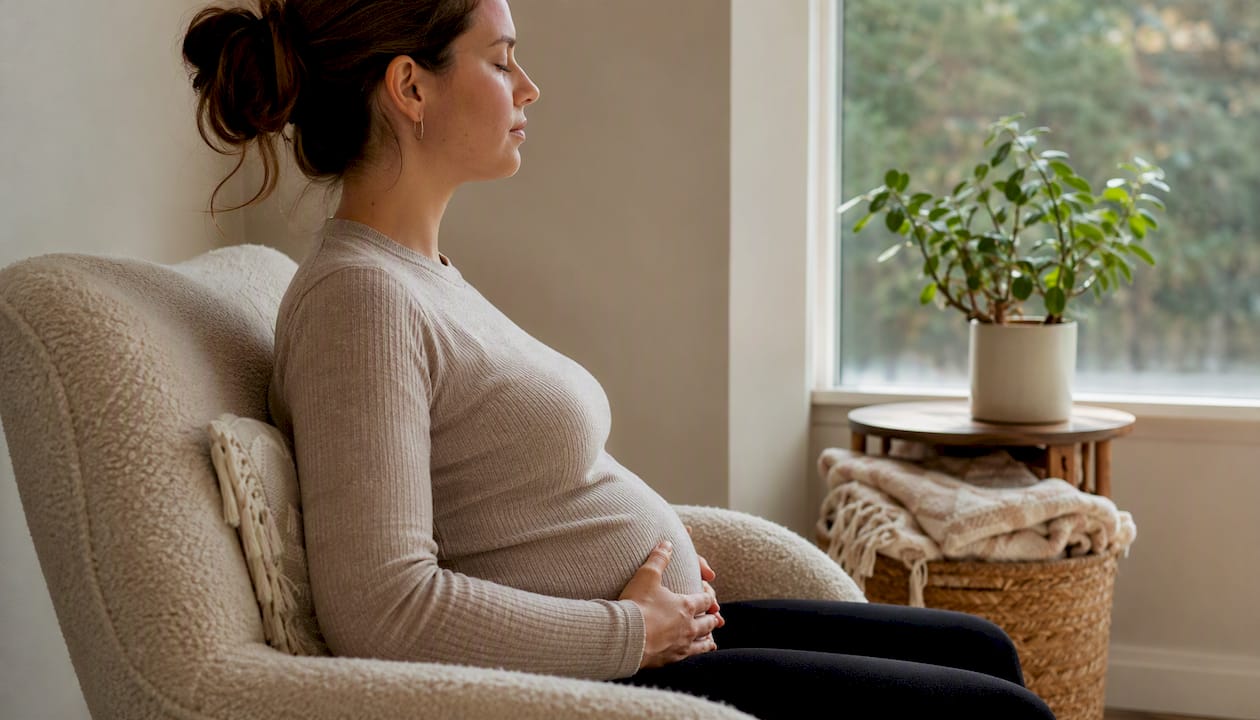
The amygdala, your brain’s threat-detection center, is hyperactive during anxiety. Slow, regulated breathing is associated with reduced amygdala reactivity and increased activity in the prefrontal cortex, the region responsible for rational appraisal and emotional regulation. The insula and anterior cingulate cortex, both involved in interoception and attention, also show changes during regulated breathing. The net effect is a shift from reactive threat-processing toward deliberate, calm evaluation.
Pro Tip: Posture matters more than most guides admit. Slumped sitting compresses the diaphragm and limits the full belly expansion that drives vagal activation. Sit tall, or lie flat, before starting any breathing practice.
What the research actually shows
The evidence base for breathing-based anxiety relief is solid at the review level, with some important nuances about what works and what does not.
The systematic review findings
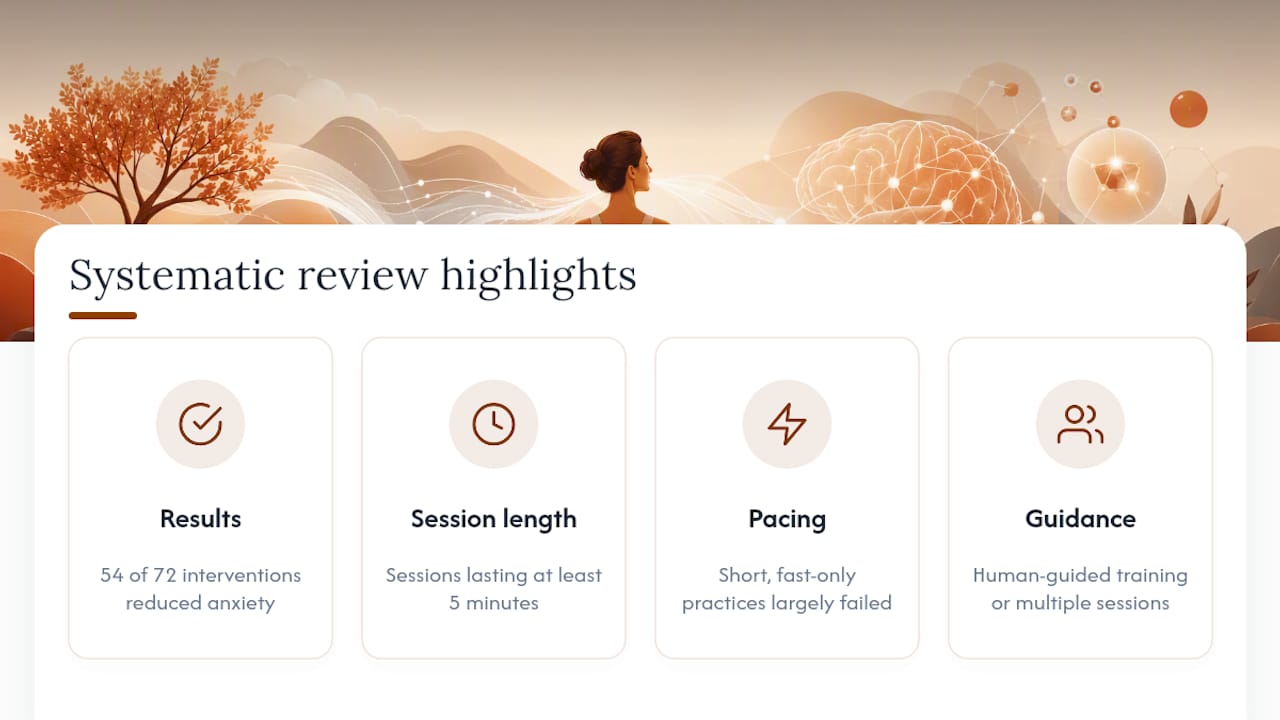
A PMC systematic review screened 58 studies and identified 72 breathing interventions. Of those, 54 significantly reduced stress or anxiety. That is a strong signal. Three parameters consistently separated effective from ineffective interventions: sessions lasting at least 5 minutes, avoiding fast-only pacing, and including human-guided training or multiple sessions. Short, fast-only practices largely failed. This matters for how you structure your own practice.
EEG and HRV studies
A small experimental study (n=27) using a within-subjects design found that slow breathing reduced subjective anxiety and produced distinct EEG spectral changes: increased power in delta, theta, and alpha bands, with beta power decreasing specifically under conditions of uncertainty during slow breathing. These are the neural signatures of a calmer, less threat-vigilant brain. The sample size is small, so treat this as a compelling early signal rather than definitive proof.
Neurophysiology reviews also distinguish between acute session effects (immediate HRV and neural changes during a single practice) and longer-term adaptations, including improved resting autonomic tone with repeated practice. Both matter. The immediate effect is why breathing helps in the moment; the cumulative effect is why daily practice builds resilience.
What the research says about technique parameters
| Study type | Key outcome reported |
|---|---|
| Systematic review (58 studies, 72 interventions) | 54 interventions reduced stress/anxiety; session ≥5 min and guided training linked to success |
| Small EEG experiment (n=27) | Slow breathing reduced subjective anxiety; increased delta/theta/alpha EEG power |
| Narrative neurophysiology review | Slow-paced breathing (~6 breaths/min) increased vagally mediated HRV and baroreflex sensitivity |
| Stanford clinical reporting | Cyclic sighing (double inhale + long exhale) reduced anxious arousal via parasympathetic activation |
Which breathing techniques actually work for anxiety
Not all techniques are equal. The mechanism behind each one matters, and so does the context in which you use it.
Diaphragmatic (belly) breathing
This is the foundation. Breathing into the belly rather than the chest engages the diaphragm fully, reduces respiratory effort, and prevents the shallow over-breathing that worsens anxiety. Cleveland Clinic recommends it as the corrective default for stress-related breathing patterns.
How to do it:
- Sit or lie down. Place one hand on your chest, one on your belly.
- Inhale through your nose. The belly hand should rise; the chest hand should stay mostly still.
- Exhale slowly through pursed lips. Feel the belly fall.
- Start with 5–10 minutes once or twice daily.
Slow-paced breathing (~4–6 breaths per minute)
Slowing your breath to roughly 4–6 cycles per minute hits the resonance frequency of the baroreflex system, maximizing HRV gains. The exhale should be longer than the inhale, typically a 4-count in and a 6-count out. This is the pacing most consistently linked to measurable parasympathetic activation in the research. For a practical guide to pacing options, this breathing improvement resource covers several structured approaches.
How to do it:
- Inhale for 4 counts, exhale for 6 counts.
- Aim for a smooth, unforced rhythm. Do not strain at the end of the exhale.
- Practice for a few minutes to see measurable effects.
Cyclic sighing
Stanford Medicine researchers have reported that cyclic sighing, a double inhale through the nose followed by a long, slow exhale, reduces anxious arousal by maximizing the exhale-driven parasympathetic response. The double inhale fully inflates the lungs, and the subsequent long exhale deflates them more completely than a single inhale allows, amplifying the vagal signal.
How to do it:
- Take a normal inhale through the nose.
- At the top of the inhale, sniff in a second, shorter breath to fully expand the lungs.
- Exhale slowly and completely through the mouth.
- Repeat 3–5 times.
4-7-8 breathing
Inhale for 4 counts, hold for 7, exhale for 8. The extended hold and long exhale are the active elements. This technique works well for pre-sleep anxiety and moments when you have time to sit quietly. It is not ideal during an acute panic episode because the breath-hold can feel distressing for some people. Skip the hold if it increases discomfort.
Box breathing
Four counts in, four counts hold, four counts out, four counts hold. Used widely in high-stress professional contexts. The symmetrical structure makes it easy to remember under pressure. It does not emphasize the exhale as strongly as slow-paced or cyclic sighing, but the slow overall pace still produces parasympathetic benefits.
Safety note: Any technique that involves breath-holding should be approached carefully if you have asthma, cardiovascular conditions, or a history of panic disorder. When in doubt, stick to simple slow diaphragmatic breathing with no holds.
How to calm an anxiety spike right now: a step-by-step protocol
This protocol is designed for acute anxiety, the kind that hits suddenly. It takes 3–6 minutes and requires nothing except a place to sit or stand.
- Stop and anchor. Sit down if possible. Place both feet flat on the floor. This is not optional, it changes your body’s threat posture.
- One slow exhale first. Before you start counting, just exhale fully. Empty the lungs. This immediately begins the vagal response.
- Inhale through your nose for 4 counts. Let your belly expand. Do not force it.
- Exhale through your mouth for 6 counts. Slow, steady, complete.
- Repeat steps 3–4 for 5–8 breath cycles. That is roughly 3–4 minutes at this pace.
- Check in. Notice whether your heart rate has dropped and your shoulders have softened. Most people feel a shift by cycle 4 or 5.
- Continue or transition. If anxiety is still high, continue for another 2 minutes. If it has eased, shift to normal breathing and stay seated for 30 seconds before standing.
What to do if you feel dizzy or tingly: Slow down further. Tingling in the hands or lips usually means you are still breathing slightly too fast. Extend the exhale by 2 more counts and breathe more shallowly until the sensation passes. If dizziness persists, stop and breathe normally.
What to do if your heart rate seems to increase: A brief heart rate increase at the start of slow breathing is normal as your body adjusts. If it continues past the first 2 minutes, stop and breathe normally. Do not push through.
Pro Tip: Build three-breath micro-practices into your day: one before your morning coffee, one before a meeting, one before bed. These short micro-habits for stress relief build the neural automaticity that makes breathing work faster when anxiety actually spikes.
A research-backed 4-week practice plan
The systematic review evidence is clear: sessions under 5 minutes and fast-only pacing rarely produce measurable results. This plan is built around those parameters.
Week-by-week progression
Week 1: Build the habit (5 minutes/day)
- One 5-minute session of diaphragmatic breathing daily, same time each day.
- Use a simple 4-in, 6-out rhythm. No apps required yet.
- Track: did you do it? Yes or no. Nothing more complex.
Week 2: Extend and add a second session (5–10 minutes/day)
- Two sessions: one in the morning, one in the evening.
- Introduce slow-paced breathing at ~6 breaths per minute.
- Begin tracking your subjective anxiety on a 1–10 scale before and after each session.
Week 3: Add guided training (10–15 minutes/day)
- Add one guided session per week using an app (Calm, Insight Timer, or a clinician-led recording). Guided sessions improve outcomes, per the systematic review evidence.
- Try cyclic sighing as an alternative on 2 days this week.
- Track: minutes practiced per week and your pre/post anxiety rating.
Week 4: Consolidate and habit-stack (15 minutes/day)
- Anchor your main session to an existing habit: after brushing your teeth, before your first meal, or during a lunch break.
- Add one 3-breath micro-practice during a predictably stressful moment in your day.
- Review your anxiety ratings from weeks 1–4. Most people notice a pattern by now.
Guided training options
- Self-guided: A timer with a simple count. Effective for people who find audio distracting.
- App-guided: Calm, Insight Timer, and similar apps offer paced breathing visuals and audio cues. These tend to improve consistency for beginners.
- Clinician-guided: A therapist or respiratory therapist can correct technique in real time, which is especially useful if you have a history of panic disorder or hyperventilation.
For a structured approach to building a smoke-free daily routine that incorporates breathing practice, habit stacking is one of the most reliable methods for making new behaviors stick.
Progress metrics worth tracking
- Subjective anxiety score (1–10) before and after each session
- Total minutes practiced per week
- Perceived reactivity: how quickly you escalate from calm to anxious during a stressful event
- Sleep quality, which tends to improve with consistent practice according to Mayo Clinic data
When deep breathing may not be enough, and when to stop
Most people tolerate slow diaphragmatic breathing without difficulty. A few situations require caution.
Common transient reactions and what to do:
- Dizziness or lightheadedness: Usually caused by breathing slightly too fast. Slow down and breathe more shallowly until it passes.
- Tingling in hands, lips, or face: A sign of mild hypocapnia (too little CO2 from over-breathing). Extend the exhale and reduce the depth of the inhale.
- Feeling more anxious: Some people find focused attention on breathing temporarily increases anxiety. Try keeping your eyes open and focusing on a fixed point in the room instead of closing them.
When to use caution or consult a clinician first:
- Panic disorder: Interoceptive focus (paying close attention to body sensations) can trigger panic in some individuals. A therapist trained in cognitive behavioral therapy or exposure-based approaches can guide you safely.
- PTSD with somatic re-experiencing: Body-focused practices can sometimes trigger flashbacks or dissociation. Work with a trauma-informed clinician before starting.
- Significant cardiopulmonary disease: Severe asthma, COPD, or unstable cardiac conditions warrant clinician oversight before beginning any structured breathing program.
- Pregnancy: Gentle diaphragmatic breathing is generally safe, but breath-holding techniques (4-7-8, box breathing) should be cleared with your OB or midwife first.
Red flags that require prompt professional attention:
- Chest pain or pressure during or after breathing exercises
- Persistent shortness of breath that does not resolve with normal breathing
- Fainting or near-fainting
- Palpitations that do not settle within a few minutes of stopping
Deep breathing is a powerful tool, but it is not a substitute for professional mental health or medical care when symptoms are severe or persistent. If anxiety is significantly affecting your daily functioning, a licensed therapist or physician is the right first call.
An editorial perspective on breathing as a frontline tool
There is a tendency in wellness writing to oversell breathing as a cure-all and in clinical writing to undersell it as “just relaxation.” Neither framing is accurate, and both do readers a disservice.
What the evidence actually shows is more specific and more interesting: slow, extended-exhale breathing is a physiological intervention with measurable effects on the autonomic nervous system, HRV, and brain activity. It is not a metaphor for calming down. It is a mechanism. The WHO reported a 25% rise in anxiety and depression globally during the COVID-19 pandemic, and one of the most consistent findings in the aftermath is that accessible, low-cost interventions matter enormously for public health. Breathing fits that profile better than almost anything else.
Where I think most guides get it wrong is in treating breathing as a standalone fix. The research is clearest when breathing is practiced consistently, with adequate session length, and ideally alongside other evidence-based approaches: therapy, physical activity, sleep hygiene, and where appropriate, medication. A single 2-minute session before a stressful meeting has real value. But the deeper benefit, the improved resting autonomic tone and reduced baseline reactivity, comes from weeks of consistent practice.
The other underappreciated point is the role of tactile and physical anchors. For people managing cravings or oral fixation alongside anxiety, pairing a breath practice with a physical cue can make it dramatically easier to initiate. A resistance necklace gives your hands and mouth something to do while you breathe, which interrupts the chest-breathing feedback loop that stress tends to lock you into. That combination of tactile cue plus deliberate breath is not just comfort. It is a behavior-change strategy with a plausible mechanism.
The bottom line: breathing works, the science is solid, and the practice is free. Use it as a frontline tool. Build it into your day before you need it. And if anxiety is running your life, pair it with professional support rather than treating it as a replacement.
Breathefree and the habit of breathing better
If you are working on quitting smoking or vaping, the anxiety piece is often the hardest part. Cravings and anxiety share the same nervous system pathway, and the same slow-exhale breathing that calms anxiety also reduces the acute intensity of a craving.
The Breathefree resistance necklace is designed specifically for this overlap. It gives you a nicotine-free tactile anchor during the moments when your hands and mouth are looking for something to do, which is exactly when breathing practice is hardest to start. Pair it with the 4-in, 6-out rhythm from this article and you have a two-part habit that addresses both the physical and neurological sides of the craving-anxiety cycle.
Over 75,000 people have used Breathefree as part of their quit journey. The habit tracker and ebook can help you log your breathing sessions alongside your cessation progress, so you can see both improving in parallel.
Sources
The sources below are the primary references cited in this article. Each one adds something distinct.
Systematic review (strongest evidence base) Breathing Practices for Stress and Anxiety Reduction — PMC: Synthesizes 58 studies and 72 interventions. The clearest available evidence on which parameters drive effectiveness.
Neurophysiology mechanisms Neurophysiological mechanisms of breathing-based well-being practices — Frontiers in Psychiatry: Explains HRV, baroreflex sensitivity, and vagal pathways in clinical detail. Useful for readers who want the mechanistic depth.
EEG and subjective anxiety study Slow breathing, EEG changes, and anxiety — PubMed: Small but well-designed experiment linking slow breathing to measurable neural changes and reduced subjective anxiety.
Clinical guidance on diaphragmatic breathing Diaphragmatic breathing — Cleveland Clinic: Practical clinical resource covering technique, mechanical benefits, and contraindications.
Vagal stimulation and blood pressure Breathing exercises to lower blood pressure — Harvard Health: Explains the exhale-driven vagal reflex and includes practical guidance on daily practice duration.
Cortisol, sleep, and habit-building Belly breathing and health benefits — Mayo Clinic Press: Covers the broader benefits of consistent practice, including cortisol reduction and sleep quality.
Cyclic sighing Cyclic sighing and anxiety — Stanford Medicine: Clinical and research context for the double-inhale technique and its parasympathetic mechanism.
- Breathing Practices for Stress and Anxiety Reduction: Conceptual Framework of Implementation Guidelines Based on a Systematic Review of the Published Literature
- Breathing exercises to lower your blood pressure - Harvard Health
- Belly breathing: Breathing more deeply can bring significant health benefits - Mayo Clinic Press
- Study linking slow breathing to EEG changes and reduced anxiety (PubMed record)