

A good relapse prevention checklist for quitting smoking covers six things: your personal triggers, a ready list of craving tools, a plan for high-risk moments, people who can back you up, a substitute for the hand-to-mouth habit, and a written plan for what you will do if you slip. Print it, fill it in this week, and keep it where you used to keep your cigarettes.
The rest of this guide walks through each item with the reasoning behind it and the free US help you can pair it with.
TL;DR
- Write down your triggers (people, places, moods, drinks) before they find you, and plan a swap for each one.
- Keep a short, ready-to-use craving list: delay, distract, breathe, drink water, talk to someone.
- Protect the first year most of all, and especially the first 30 days.
- Treat a slip as information: stop again right away, find the trigger, adjust the plan.
- Free help exists: call 1-800-QUIT-NOW or text QUIT to 47848.
Table of Contents
- Why a checklist works better than willpower
- Step 1: Check your own risk level
- Step 2: Map your triggers
- Step 3: Build a craving toolkit
- Step 4: Plan for high-risk moments
- Step 5: Line up support
- Step 6: Know the early warning signs
- Step 7: The all-or-nothing rule and the slip plan
- Our perspective
- Put a tool in your checklist
- Your one-page relapse prevention checklist
- FAQ
- Sources
Why a checklist works better than willpower
A craving does not ask whether you are motivated. It arrives at the end of a stressful meeting, with a beer, or when a coworker steps outside. A checklist moves the decisions to a calm moment, so that in the hard moment you only have to follow steps.
The VA’s relapse-prevention workbook makes the same point: preparation for coping, not willpower, is the key. It also advises keeping your guard up for at least a year after quitting.
The NCCN patient guideline on quitting smoking names the same core areas a checklist should cover: coping with withdrawal symptoms and cravings, recognizing triggers, dealing with stress, and handling times when you might be tempted to smoke. The checklist below is built around those areas.
Step 1: Check your own risk level
Some situations raise the odds of a return to smoking. The NCCN guideline lists quitting less than a year ago, especially less than 30 days ago, and smoking within 30 minutes of waking among the main risk factors.
That is not a verdict. It tells you where to put your effort:
- [ ] I know my quit date and how many days I am past it.
- [ ] If I am inside the first 30 days, I have scheduled extra support this week (a call, a text program, a friend).
- [ ] If I used to smoke soon after waking, I have changed my first 30 minutes of the day (shower first, water first, a different spot for coffee).
- [ ] I wrote down my top three reasons for quitting and put them where I will see them.
Step 2: Map your triggers
Smokefree.gov defines triggers as people, places, things and situations that can prompt an urge, even years after quitting. Knowing yours lets you prepare for them instead of being ambushed.
The VA workbook lists common ones: flare-ups of negative mood, stress crises, drinking alcohol, rewarding yourself after good moods, being around people who smoke, and the thought that you can have just one. The NCCN guideline adds coffee and social situations to the list.
Build a table for yourself. Here is a template with examples:
| Trigger | When it hits | My swap |
|---|---|---|
| Morning coffee | First 30 minutes of the day | Drink water first, change where I sit |
| Work break | Mid-morning and after lunch | Brisk walk, call a friend, mouth substitute |
| Alcohol | Evenings, weekends | Water or a non-alcoholic drink, leave early |
| Stress spike | Deadlines, arguments | Five slow breaths, five-minute timeout |
| Driving | Commute | New route, something in my mouth |
| Friends who smoke | Parties, patio | Stand with non-smokers, ask for support |
Checklist items:
- [ ] I listed at least five personal triggers.
- [ ] Each trigger has a specific swap, not just “resist.”
- [ ] I told one person which triggers are hardest.
- [ ] I removed lighters, ashtrays and leftover packs from home, car and bag.
For the home side of this, our guide to smoking triggers at home shows how to change a room before the craving arrives. If coffee is your big one, see how to keep coffee while quitting.
Step 3: Build a craving toolkit
Cravings are temporary. Smokefree.gov says that cravings fade over time and that you should find something else to do and keep trying until you find what works. Our own guide on how long each craving lasts covers the timeline and tools.
The 5 Ds
Health Canada’s 5 Ds are Delay, Distract, Deep breathing, Drink water and Discuss. Its infographic spells them out as setting a timer for five minutes, doing something that takes concentration, breathing deeply, drinking cold water and talking to someone you trust. The American Cancer Society suggests a similar delay, waiting at least 10 minutes when you are about to light up, because the urge may lessen.

VCU Massey Comprehensive Cancer Center notes that nicotine withdrawal usually lasts about a week or two and repeats the 5 Ds as a core coping set.
Keep your mouth busy
Many ex-smokers miss the hand-to-mouth motion as much as the nicotine. The American Cancer Society recommends other things for your mouth, such as sugarless gum, hard candy, carrot sticks or sunflower seeds. Smokefree.gov lists keeping your mouth busy, drinking water and taking slow deep breaths, repeated 10 times or until you feel calmer.
Checklist items:
- [ ] I wrote a craving list I can use without thinking (walk, water, breathing, call).
- [ ] I keep at least two mouth substitutes in every place I used to smoke.
- [ ] I practiced the slow-breath routine once while calm, so it is familiar when I need it.
- [ ] I know the five-minute and ten-minute delay rules.
Our replace your smoking ritual guide goes deeper on swapping the ritual, and a 10-minute workout is a quick option when you have the space.
Step 4: Plan for high-risk moments
General willpower fails at specific times. Plan these in advance:
Work breaks. The NCCN guideline specifically mentions break time at work and being around people who smoke as high-risk moments. The American Cancer Society suggests taking a brisk walk instead of a tobacco break. We cover four quick options in replacing smoke breaks at work and a breathing routine in 10 slow breaths for work cravings.
Alcohol and social events. Decide before you go: what you will drink, where you will stand, when you will leave. The American Cancer Society advises staying away from people and places that tempt you, at least early on. It says you will handle temptations more easily later.
Stress and rumination. A bad day is the classic reason to “just have one.” If your mind loops on a mistake or a worry, a short body reset can break the loop before it turns into a craving. This walkthrough on how to stop rumination in 90 seconds fits neatly into a plan for tense work breaks and social evenings.
Changing routine. The VA workbook suggests driving a different route, staying in non-smoking areas and leaving a situation when the urge is strong. Smokefree.gov adds changing where you eat lunch.
Checklist items:
- [ ] I have a plan for my break at work.
- [ ] I have a script for declining a cigarette (“No thanks, I quit”).
- [ ] I decided what I will drink and when I will leave at social events.
- [ ] I have a go-to move for stress: five-minute timeout, walk, breathing.
- [ ] I changed one daily route or routine.
Step 5: Line up support
Going it alone is optional, and most people do better with backup. Smokefree.gov recommends reaching out to your chosen supporters and being specific about the help you need during cravings. It also suggests telling friends and family that you are in it “for the long haul.”
Free, evidence-based help in the United States:
| Resource | How to reach it |
|---|---|
| Quitline coaching and a quit plan | 1-800-QUIT-NOW (1-800-784-8669), free and confidential |
| Text program | Text QUIT to 47848 (SmokefreeTXT) |
| App | quitSTART |
| Counseling and medication | Ask your health care professional |
The CDC says counseling and medication together give people the best chance of quitting for good. If you have not talked to a doctor, nurse or pharmacist about medication, put that on the checklist. The American Heart Association also offers a guide to choosing a quit program that stresses counseling, behavioral therapy and fit.
Checklist items:
- [ ] I named at least two supporters and told them exactly what to do when I call.
- [ ] I saved 1-800-QUIT-NOW in my phone and texted QUIT to 47848.
- [ ] I asked a health care professional about quit medication.
- [ ] I joined a community or group where I can check in.
More options are in our quit smoking support resources guide.
Step 6: Know the early warning signs
Relapse rarely starts with a cigarette. It starts with a drift: skipping your tools, isolating, telling yourself one won’t hurt, romanticizing smoking. The VA workbook flags rationalizations like “just have one cigarette” as a temptation in their own right.
Once a week, run this quick scan:
- [ ] Am I more irritable, restless or stressed than usual?
- [ ] Have I stopped using my craving tools?
- [ ] Have I been avoiding my supporters?
- [ ] Have I been drinking more, or spending time with smokers?
- [ ] Have I caught myself bargaining (“just one, just tonight”)?
Two or more yes answers mean it is time to act that day: call a supporter, revisit your trigger table, and add a tool. Our article on what causes relapse after quitting explains these patterns in more depth.
Step 7: The all-or-nothing rule and the slip plan
The VA workbook is blunt: do whatever it takes to avoid even one puff after your quit date, because any smoking after that usually leads back to regular smoking. That rule is your first line of defense.
But slips happen, and the NCCN guideline notes they are common and encourages trying again, with help from a health care professional. MedlinePlus gives a clear recovery sequence for dealing with a slip:
- Stop smoking again right away.
- Get rid of the rest of the pack, or ask whoever gave you cigarettes not to give you more.
- Do not beat yourself up.
- Get back to basics and remind yourself why you want to quit.
- Learn from what made you slip.
- Adopt new habits and skills.
MedlinePlus also says a temporary slip does not mean you must stop nicotine replacement therapy. The VA workbook suggests using the lapse as a learning opportunity, identifying the trigger and analyzing what led to it.
Write a short slip debrief and keep it in your checklist:
- What was happening in the hour before?
- Who was I with, and what was I feeling?
- Which tool did I skip, or which tool did I not have?
- What will I change before that situation comes up again?
Our perspective
Most checklists tell you what to avoid. In our experience, the part people underrate is what to put in your hands and mouth instead. For many people, the ritual is as strong as the habit itself: the reach, the hold, the breath in, the pause.
That is why we built the BreatheFree resistance necklace as a nicotine-free, inhalation-free oral fixation tool. It is designed to give your hands and mouth something to do at the exact moments your checklist flags, whether that is a work break, a drive or a stressful evening. The products are solid and plant-fiber based, so you can use them in an office or on a flight, and the flavors are natural.
We think the best plan combines proven support (a quitline, a clinician, people you trust) with a physical replacement for the ritual. Our community of users, which we say numbers over 75,000 quitters, is there so that you are not working through the checklist alone.
Tommy
Put a tool in your checklist
If the hand-to-mouth ritual is one of your triggers, you can add a physical swap to Step 3. The BreatheFree Resistance Necklace is $39.95, and flavor refills are $29.95. Both are nicotine-free, and our 30-day money-back guarantee applies.
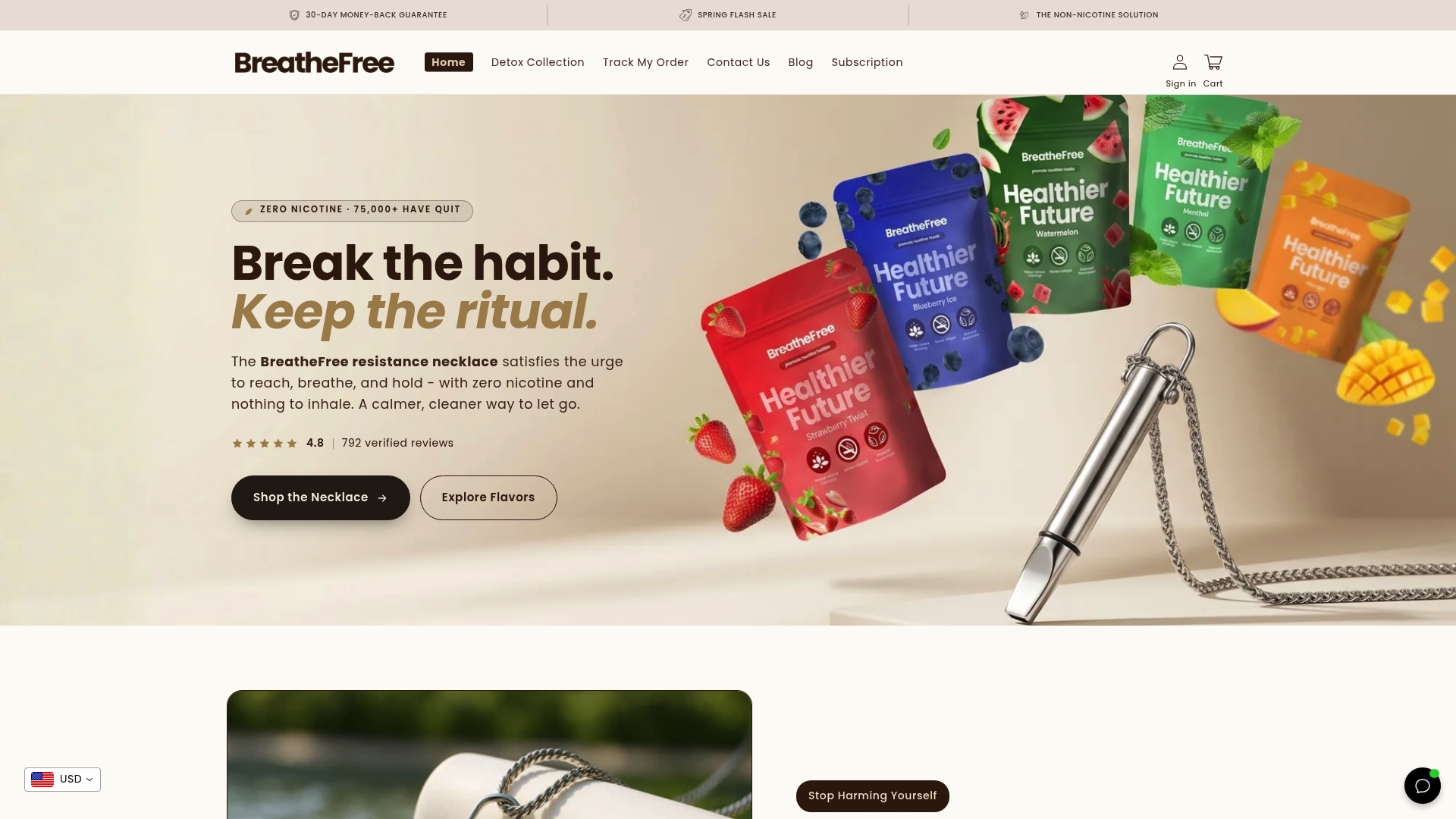
Wear it where your cigarettes used to be, and reach for it at each high-risk moment in your table. If you want regular refills without reordering, see our subscription page. You can also track your progress with the habit tracker.
Your one-page relapse prevention checklist
Copy this into your notes app or onto paper:
Daily
- [ ] Water first thing in the morning
- [ ] Craving list within reach
- [ ] Mouth substitute in bag, car and desk
- [ ] One supportive check-in (text, call or community)
Before a risky situation
- [ ] Know my swap and my exit time
- [ ] Tell someone where I am going
- [ ] Plan my drink and where I will stand
When a craving hits
- [ ] Delay 5 to 10 minutes
- [ ] Distract with something that needs concentration
- [ ] Breathe slowly 10 times
- [ ] Drink cold water
- [ ] Discuss with someone, or call 1-800-QUIT-NOW
Weekly
- [ ] Run the warning-sign scan
- [ ] Update the trigger table
- [ ] Plan next week’s high-risk events
If I slip
- [ ] Stop again right away
- [ ] Remove cigarettes
- [ ] Skip the self-blame
- [ ] Write the debrief
- [ ] Contact a supporter or health care professional
For more daily strategies, our ex-smoker coping guide pairs well with this checklist.
FAQ
How do I create a relapse prevention plan?
Start with your reasons for quitting, then list your triggers and a specific swap for each. Add a craving list, a set of supporters with exact asks, and a slip plan. Smokefree.gov has a build-your-quit-plan tool that walks you through this.
What are the 5 Ds of relapse prevention?
The 5 Ds are Delay, Distract, Deep breathing, Drink water and Discuss. They are a quick routine for sudden cravings. Health Canada’s version suggests a five-minute timer and talking to someone you trust, as in its coping infographic.
How long should I keep my guard up after quitting?
The VA workbook advises staying watchful for at least one year after quitting. The NCCN guideline lists quitting less than a year ago, and especially less than 30 days ago, as a risk factor. Smokefree.gov says triggers can prompt urges even years later, so keep the checklist handy.
What should I do right after smoking a cigarette?
Stop again right away, get rid of any remaining cigarettes, and skip the self-criticism. Then identify the trigger and adjust your plan, as MedlinePlus advises. Call 1-800-QUIT-NOW or a health care professional if you want help restarting.
Sources
- NCCN Guidelines for Patients: Quitting Smoking
- VA: Smoking Cessation workbook
- American Cancer Society: Staying Tobacco-free After You Quit
- Smokefree.gov: How to Stay Smokefree
- Smokefree.gov: How to Manage Cravings
- Smokefree.gov: Build a Plan to Quit Smoking or Vaping
- Health Canada: Smoking triggers and coping 101
- VCU Massey Comprehensive Cancer Center: Managing withdrawal symptoms
- CDC: How to Quit Smoking
- American Heart Association: Help! I Want to Quit Smoking!
- MedlinePlus: Dealing with a slip up
- Interrupt rumination in 90 seconds