

The craving at the end of the workday is rarely about the cigarette alone. It is a habit your brain has tied to a time, a place and a feeling of finally being done. The fix is to give your mouth, hands and routine something else to do in that window, and to ride out the urge, which passes. A nicotine-free oral substitute such as our resistance necklace is built for exactly that moment.
TL;DR
- After-work cravings come from a learned link between your routine (a break, the drive home, coffee, a drink) and nicotine, plus the stress release you got from smoking.
- A single craving is short. Set a 10-minute timer, breathe slowly and keep your mouth and hands busy until it fades.
- Change the setup, not just your willpower: a different route, a different break time, a different first thing you do when you get home.
- Withdrawal is usually hardest in the first week and eases over the first month, but the habit side of cravings can linger, so plan for it.
- Free U.S. quit support is available at 1-800-QUIT-NOW, and a non-nicotine tool for your hands and mouth fits alongside it.
Table of Contents
- Why the end of the workday is such a strong trigger
- How long an after-work craving lasts
- Your first ten minutes: a nicotine-free craving routine
- Rebuild the routine around 5 p.m.
- A sample after-work plan
- Planning for the slip-ups
- Free U.S. support that works alongside your tools
- What BreatheFree offers for the 5 p.m. window
- Our perspective
- FAQ
- Sources
Why the end of the workday is such a strong trigger
If you smoked for years, your day had punctuation marks: the first one with coffee, the one at the break, the one at the end of work. Each repeated pairing taught your brain to expect nicotine at that moment.
Mayo Clinic explains that how you feel or what you do while using nicotine can become linked in the brain. A smoke break with coworkers can later set off a craving at that time of day or around those same people.
The CDC’s Tips From Former Smokers campaign lists daily routines tied to smoking as triggers: breaks, coffee, finishing a meal, talking with friends and using the phone. Feelings count too. Stress, feeling down, happiness and relaxation can all bring on an urge.
That explains why 5 p.m. is so loaded. It combines three triggers at once:
- A routine. Closing the laptop or clocking out was your cue.
- A transition. Moving from work to home or from desk to car is a natural “reward” moment.
- A feeling. Relief, tiredness or leftover stress from the day is exactly what you used cigarettes to manage.
Mayo Clinic’s nicotine-dependence page also names coffee, work breaks, phone calls, alcohol, driving and time with friends as common urge triggers. Many of those show up between the end of the shift and dinner.
There is a body side, too
The CDC describes how nicotine triggers the release of feel-good brain chemicals, and repeated use changes how the brain works so that it seems you need nicotine to feel okay. When you stop, the brain gets irritable, which can mean anxiety, trouble concentrating, poor sleep and strong urges. Those urges improve a few weeks after quitting.
So an after-work craving has two layers: the chemical pull that fades over weeks, and the habit pull that is tied to the clock. This article is mostly about the second one, because that is the one you can plan around. If you want the withdrawal side in more detail, our guide to what withdrawal symptoms to expect without nicotine covers it.
How long an after-work craving lasts
The most useful fact for a bad evening is that a craving is a wave, not a permanent state. Mayo Clinic advises setting an alarm for 10 minutes and doing something distracting or enjoyable, because cravings often ease within minutes.
Over the longer run, the National Cancer Institute (NCI) says cravings can start within an hour or two of your last tobacco use and occur often for days or weeks, then spread out. Withdrawal symptoms are usually worst in the first week, peak around the first 3 days and typically drop in intensity over the first month. Occasional mild cravings can still appear months or even years later.
Mayo Clinic adds that cravings get easier after the first weeks but do not vanish, and that the habit of smoking is often the craving that lasts longest. It also notes that relapse within six months of quitting is common. That is not a reason to worry. It is a reason to build an after-work plan now, while motivation is high. Our short breakdown of how long each craving lasts and what to use pairs well with this section.

Your first ten minutes: a nicotine-free craving routine
When the urge hits at 5:10 p.m., you do not need a philosophy. You need a short script you can run on autopilot. Here is one built from guidance by U.S. public health agencies.
- Name it and start a timer. Tell yourself the craving will pass, then set 10 minutes. The NCI advises reminding yourself that cravings pass rather than fighting them head-on.
- Take 10 slow breaths. The NCI suggests breathing in through your nose and out through your mouth. That out-through-the-mouth pattern is also the closest thing to the motion of smoking, which is why it feels familiar.
- Give your mouth a job. The NCI lists carrots, pickles, apples, celery, sugarless gum and hard candy for a busy mouth. Keep a few within reach of your desk and your car.
- Move for ten minutes. Mayo Clinic says ten-minute walks, indoors or out, can lessen cigarette cravings and take the edge off irritability and tension.
- Write down your reason. Mayo Clinic suggests keeping your main reason for quitting written down to read when a craving hits. A note on your phone lock screen works.
The New York City Health Department’s fact sheet adds a useful split: if you feel anxious or irritable, go for a walk, step outside, or try deep breathing or meditation. If you feel restless or can’t concentrate, distract yourself with a snack, gum, water or a call to a friend. Match the tool to the feeling.
Where a nicotine-free oral tool fits
Chewing gum and snacks work, but they are awkward in a meeting, a parking lot or a commute. Our resistance necklace is designed for the oral-fixation part of the craving: you hold it to your mouth and draw through it the way you would a cigarette, with no nicotine and nothing to light or inhale. It is fully solid and plant-fiber based, so you can use it anywhere, including flights and offices. For more on why this works, see our guide to immediate oral substitutes.
Rebuild the routine around 5 p.m.
Coping in the moment is half the job. The other half is changing the cue so the craving shows up less often. Smokefree.gov recommends replacing pattern triggers with gum, sugar-free candy or a straw, keeping your hands busy, getting moving and changing your routine, for instance having coffee at a different time or brushing your teeth after a meal.
Here is how to apply that to a typical workday end.
Change the exit
If you always stepped outside at the end of the day, do something different with the same minutes. Take a short walk in the opposite direction, stretch at your desk, or call someone on the way to the car. If your commute is the trigger, Smokefree’s trigger guidance suggests trying a different route or listening to something new to change your focus.
Avoid the old smoking crowd for a while
The NYC Health Department advises skipping work breaks with people who smoke or vape. Take a walk outside or schedule your break at a different time. This is temporary. After the first weeks you can rejoin them without the pull.
Rethink the coffee and the drink
Coffee and alcohol are both on Mayo Clinic’s trigger list. The NYC fact sheet also notes that cutting back on caffeine can help, because quitting changes how your body processes caffeine and the same amount hits harder. If your afternoon coffee leaves you jittery, that can feel like a craving. Our guide on keeping coffee while quitting walks through it.

Plan the first 15 minutes at home
The urge often returns at the door. Decide in advance what you do first: change clothes, drink a glass of water, start dinner prep, or sit with your oral substitute while you decompress. Changing the room can also help, as we explain in smoking triggers at home. If you work from home, the cue is a calendar problem rather than a location one, and these calendar-ready moves for remote workers are made for it.
Replace the stress release, not just the cigarette
Many people smoked to unwind. Smokefree.gov’s emotional-trigger tips include talking about your feelings with a friend or family member, taking slow deep breaths, exercising so your brain releases feel-good endorphins, and listening to calming music, which can slow heart rate and lower blood pressure and stress hormones. The CDC says that when you quit, you work out how to get through your routines and handle stress without cigarettes, and most people who quit for good report feeling better after a while. If emotional reliance is the heart of your cravings, this nicotine-free plan for emotional dependence goes deeper.
A sample after-work plan
| Time | Trigger | Swap |
|---|---|---|
| Last hour of work | Anticipating the break | Water, a snack from your drawer, 10 slow breaths |
| Clock-out | The old cigarette moment | Short walk the other way, or hold your oral substitute while you pack up |
| Commute | Driving, phone, music | New route or playlist, gum or your substitute within reach |
| Arriving home | Transition, relief | Change clothes, a drink of water, one 10-minute task |
| Evening | Alcohol, TV, friends | Keep a hand-and-mouth tool nearby, skip smoking spots for now |
Write it for your own schedule and put it where you will see it. A habit tracker helps you see the streak build; we offer a habit tracker for this. If workplace smoke breaks are the core of your problem, our post on replacing smoke breaks at work gives four quick swaps, and 10 slow breaths for work cravings shows the breathing routine in detail.
Planning for the slip-ups
Cravings tend to return on stressful days, so a plan beats improvising. A written relapse-prevention plan names your triggers, your warning signs and the first thing you do when you notice them. This single-page relapse prevention plan is a useful template for laying out your high-risk times, and your 5 p.m. window belongs at the top of it.
If a craving wins once, treat it as information about which trigger was strongest, then adjust the plan the next day.
Free U.S. support that works alongside your tools
You do not have to do this alone. The CDC lists free support including quitlines at 1-800-QUIT-NOW, texting QUITNOW to 333888, the quitSTART app, and online resources at Smokefree.gov. Smokefree.gov also lists LiveHelp chat (Monday to Friday, 8 a.m. to 11 p.m. Eastern, also in Spanish) and the 1-877-44U-QUIT line, available 24/7 for tips, on its quit methods page.
The same page notes two non-nicotine prescription medicines, bupropion SR and varenicline. Both need a doctor’s prescription, so talk to your doctor or pharmacist if you want to consider them, especially if you have a medical condition or take other medicines. The CDC says counseling plus medication gives the best chance of quitting for good, and that free quitline coaching can help you manage urges and cravings.
If withdrawal is making it hard to function, with severe low mood, anxiety or sleeplessness that does not ease, call the quitline or see your doctor. The NCI lists depression and anxiety among common withdrawal symptoms, and they are worth raising with a professional.
What BreatheFree offers for the 5 p.m. window
The BreatheFree Resistance Necklace costs $39.95 and gives you a nicotine-free, chemical-free way to satisfy the hand-to-mouth ritual without inhaling smoke or vapor. Flavor Refills are $29.95, and there is a range of natural flavors so the ritual stays pleasant. Every order is backed by our 30-day money-back guarantee. A subscription option is also available on our subscription page.
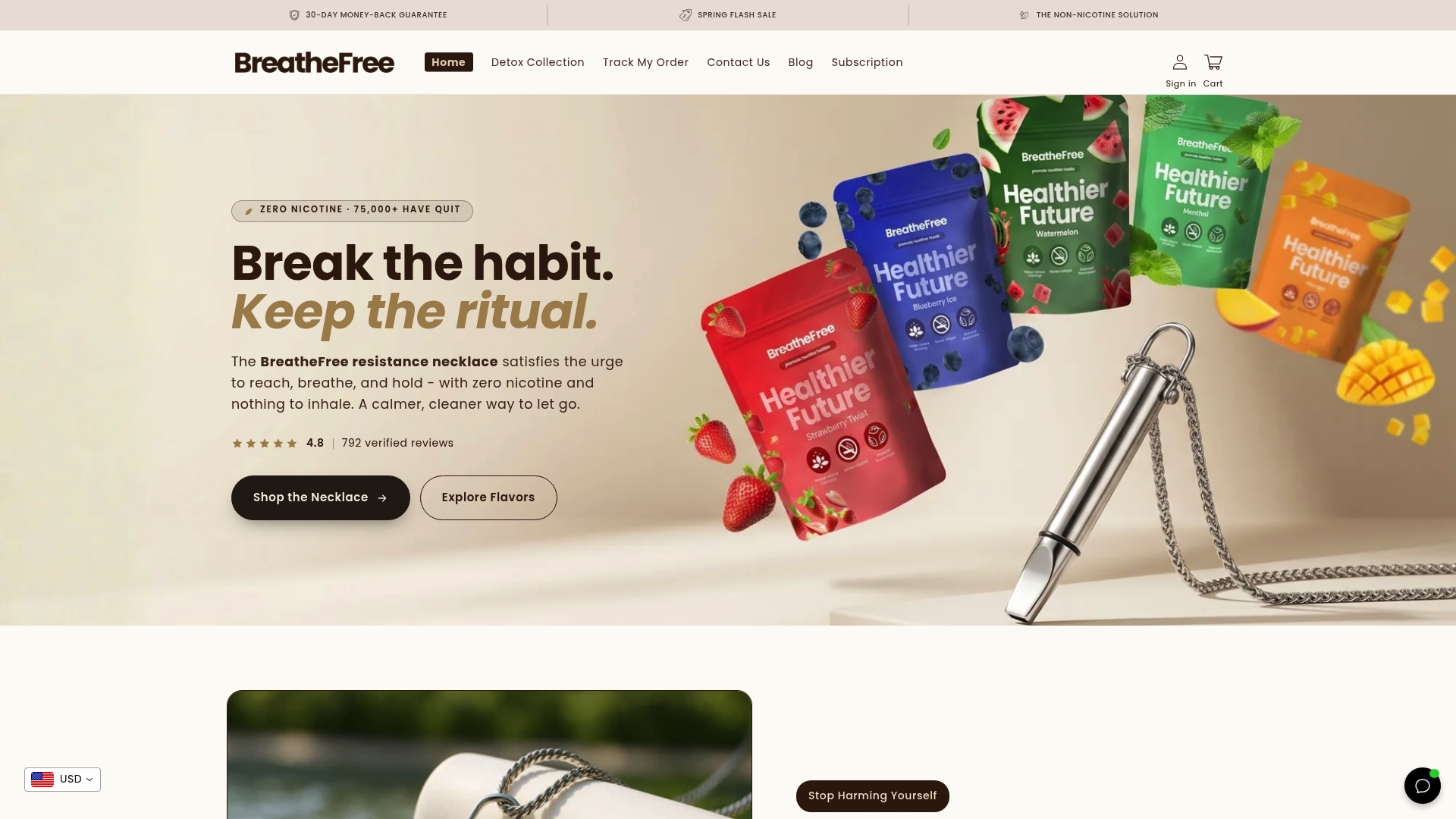
Wear it to work, keep it in the car, and reach for it at the exact moment your old routine would have called for a cigarette.
Our perspective
Most people think the after-work craving is a test of willpower. We see it as a gap in the day. For years a cigarette filled the space between work and home, and it gave your hands something to do, your mouth something to hold and your breath a slow rhythm.
That is why we built a tool around the ritual instead of around a substance. The BreatheFree necklace has no nicotine and nothing to inhale, so it fills the gap without feeding the dependence. It is solid and plant-fiber based, which means it goes with you into the office, onto a flight or into the car.
Pair it with a changed routine, a plan for your trigger times and the free quitline, and the 5 p.m. wave becomes something you notice, handle and watch pass. Our community has grown past 75,000 people who say they have quit this way, and we want you to be next.
Tommy
FAQ
Why do I only crave cigarettes after work?
Because your brain linked that time of day with smoking. Breaks, coffee, driving and relief from stress are all recognized triggers. Changing the routine and keeping your mouth and hands busy weakens the link over time.
How long does an after-work craving last?
Most individual cravings ease within minutes, which is why Mayo Clinic recommends a 10-minute timer. Overall, the NCI says withdrawal is usually strongest in the first week and eases over the first month, though milder cravings can come back later.
Can I handle cravings without nicotine replacement?
Many people do use non-nicotine strategies: breathing, movement, a busy mouth, a changed routine and support from a quitline. A hand-to-mouth tool like our necklace covers the ritual. If you are considering medication, a doctor can advise you, and the CDC notes that combining counseling with medication gives the best chance of quitting for good.
What should I do on the drive home?
Change the route or the audio, keep gum or your oral substitute within reach, and avoid stopping where you used to smoke. Smokefree.gov suggests a new route or new music to shift your focus when the commute triggers an urge.
Sources
- Quitting smoking: 10 ways to resist tobacco cravings, Mayo Clinic
- Nicotine dependence symptoms and causes, Mayo Clinic
- Why Quitting Smoking Is Hard, CDC Tips From Former Smokers
- Tips for Coping with Nicotine Withdrawal and Triggers, National Cancer Institute
- Tobacco Treatment: Tips for Dealing With Cravings, NYC Health Department
- Know Your Smoking Triggers, Smokefree.gov
- Explore Quit Methods, Smokefree.gov
- Celebrate a Fresh Start, CDC