

There is no single best flavor for cravings. The reliable approach is to test two or three contrasting flavor profiles, cooling, fruity, and neutral, over a short trial period, and pair each one with slow breathing and a quick change of activity. Nicotine-free oral fixation tools, including BreatheFree flavor refills, give you a mouth substitute while you figure out what actually interrupts your specific urge pattern.
TL;DR:
- Testing contrasting flavor profiles over a week helps determine which one most effectively reduces cravings for you.
- Starting with flavors unlike your old cigarette or vape can prevent reinforcing conditioned cues, especially with known flavor memories like menthol or fruit.
- A 7-day urge-tracking routine with daily rotation minimizes wasted time and ensures you identify the most helpful flavor for your trigger patterns.
- Flavor refills are non-nicotine tools suited for ritual replacement but should be used alongside evidence-based pharmacological treatments for higher nicotine dependence.
- Flavors with strong sensory impact, such as menthol or novel profiles, are generally more effective in distracting the brain from cravings than milder, familiar tastes.
Table of Contents
- Why flavor choice matters: how cues and habit shape results
- How flavor families tend to perform for craving interruption
- A 7-day test and rotation routine to find your flavor
- Safety, limits, and when to talk to a clinician
- Specific flavors and ingredients studied for craving reduction
- How the sensory experience of a flavor affects cravings
- When and how often to use a flavor refill for best results
- Common mistakes people make with craving-flavor strategies
- Why we built BreatheFree flavor refills around ritual, not nicotine
- Try BreatheFree flavor refills and the resistance necklace
- FAQ
- Sources
Why flavor choice matters: how cues and habit shape results
Cravings rarely strike at random. They tend to follow specific triggers, a coffee break, a drive home, a stressful phone call, and the National Cancer Institute notes that keeping the mouth occupied with a substitute is one practical way to interrupt that pattern rather than fight it head-on. The NCI frames this as trigger planning paired with oral substitution, not a search for one perfect flavor.
The CDC’s guidance on quitting medicines draws an important line here: nicotine medicines work pharmacologically, while oral substitutes like flavor refills work behaviorally by giving your hands and mouth something familiar to do. They are two different mechanisms, and conflating them sets up unrealistic expectations for a flavored refill.
Flavor research adds a layer of nuance. A review of flavor chemicals and nicotine reward pathways found that menthol and certain fruit flavorants can act as conditioned cues that reinforce nicotine use patterns. That has a direct practical implication for anyone quitting:
- Avoid reaching for the exact flavor profile your cigarettes or vape used.
- Treat strong flavor memories (a signature menthol or fruit flavor) as a cue to work around, not match.
- Start with something your old habit never tasted like.
Menthol and some fruit flavorants have shown reinforcement properties in nicotine studies, according to research on ENDS flavors and nicotine receptors, which is one reason contrast beats imitation when picking a replacement flavor.
How flavor families tend to perform for craving interruption
Different flavor categories interrupt different triggers, and none of them works the same way for everyone. Here is a practical map based on how people typically use them.

Menthol and other cooling flavors have a mixed track record. One experimental study found that menthol-flavored e-cigarettes produced the largest drop in cigarettes smoked per day compared with other flavors tested over a six-week period. That is a meaningful data point, but it involved nicotine-containing products, and for someone who smoked menthols for years, a menthol-flavored refill risks reinforcing the same taste memory rather than breaking it.
Fruity and green-apple profiles are often the most immediately appealing, which helps people stick with the habit of reaching for the refill instead of a cigarette. The flip side is that some fruit flavor chemicals, including compounds like farnesol and farnesene, have shown reward-related effects in preclinical research, so a fruity refill is not automatically a neutral choice if your prior vape flavor was also fruit-based.
Sweet and dessert-style flavors are pleasant but have shown less consistent ability to suppress cigarette use in available research compared with cooling profiles.
Neutral and novel flavors, herbal blends, mild citrus, unfamiliar botanical notes, tend to work well precisely because they contrast with whatever your nicotine product tasted like before.
A simple rule follows from this: if your habitual cigarette or vape had a strong signature flavor, start your test with something that tastes nothing like it. A longtime menthol smoker is usually better off trying a neutral or citrus refill first rather than reaching for another mint.
A 7-day test and rotation routine to find your flavor
Guessing wastes time. A short, structured test tells you within a week whether a flavor is actually doing anything for your cravings.
- Pick two or three contrasting refills, one neutral or herbal, one cooling or fruity depending on your smoking history, and keep each one in a separate, clearly labeled slot in your resistance necklace.
- Assign one flavor per day or every two days so you are never guessing which one you are testing.
- When an urge hits, put the refill in your mouth immediately rather than waiting for the craving to peak.
- Take three or four slow, deep breaths while you hold it, in through the nose, out through the mouth.
- Switch activities for five to ten minutes, step outside, do a quick chore, text someone, anything that removes you from the trigger environment.
- Rate the urge from 1 to 5 before and after, and jot one line: time, trigger, flavor used, before and after score.
- After seven days, compare your notes and keep the flavor that most consistently dropped your urge intensity or shortened how long cravings lasted.
If none of the flavors move the needle after a full week, rotate in a new profile rather than sticking with one that is not working, and if urges remain frequent or intense despite consistent use, that is a signal to talk with a clinician about evidence-based options such as patches, gum, or lozenges.
Pro Tip: Log cravings in your phone’s notes app right after they pass, not hours later. Memory fades fast and the pattern only shows up when the entries are accurate.
Safety, limits, and when to talk to a clinician
Flavor refills give you ritual and mouth occupation. They do not deliver nicotine, and they are not a substitute for treatment when withdrawal is pharmacologically driven. For people with moderate to high nicotine dependence, the CDC notes that evidence-based medicines meaningfully improve the odds of quitting successfully, and a flavored refill works best as a companion to that plan, not a replacement for it.
Watch for signs that behavioral tools alone are not enough:
- Cravings that keep escalating instead of leveling off after the first week or two.
- Withdrawal symptoms, irritability, poor sleep, trouble concentrating, that start interfering with work or relationships.
- Repeated relapses despite consistent use of oral substitutes and trigger planning.
Any of these is a reasonable prompt to check in with a clinician or pharmacist. Short-acting options like gum or lozenges can be combined with a patch for persistent withdrawal, and a clinician can help with dosing and timing rather than leaving you to guess. Keep your behavioral routine running in parallel. It is not a competition between flavor refills and medicine. It is about having both available depending on what a given day demands.
Specific flavors and ingredients studied for craving reduction
The research here is narrower than marketing copy usually suggests. Menthol showed the largest reduction in cigarettes smoked per day in one controlled study of flavored e-cigarettes, but that study used nicotine-containing products, so it says more about menthol’s behavioral pull than about nicotine-free menthol refills specifically.
A separate 2024 prospective cohort study of flavored oral nicotine products followed 1,393 participants and found a 15.4% quit proportion among predominant fruit users at six months, compared with 11.6% among predominant mint users. Again, these products contained nicotine, so the result cannot be read as proof that fruit-flavored, nicotine-free refills cause quitting. What it does suggest is that flavor preference tracks with sustained engagement, people stick with flavors they enjoy, and sticking with the substitute matters more than the specific flavor chemistry.
On the ingredient side, reward-related research on flavor chemicals has flagged compounds like farnesol and farnesene, found in some green-apple flavorants, as having measurable effects in preclinical reward models. That is a reason for caution with very strong fruit profiles, not a reason to avoid fruit flavors altogether.
The honest takeaway: no flavor or ingredient has been shown to reduce cravings on its own. What the evidence supports is that flavor appeal keeps people reaching for the substitute instead of a cigarette, which is a behavioral win even without a pharmacological one.
How the sensory experience of a flavor affects cravings
The sensory hit, the cooling sensation of menthol, the sharp sweetness of a fruit note, the warmth of a spice blend, matters because it gives your brain something to register as “done” when a craving would otherwise go unanswered. Smoking and vaping deliver a fast, intense sensory package: heat, throat sensation, taste, and the hand-to-mouth motion, all within seconds. A nicotine-free refill can replicate several of those sensory layers minus the substance itself.
Intensity matters more than complexity. A faint or watered-down flavor is easy to ignore mid-craving, while a sharp, distinct one is harder to tune out and gives your attention somewhere to go. This is part of why menthol produced a measurable drop in cigarettes smoked in controlled testing: the cooling sensation is immediate and hard to miss.
Novelty plays a role too. A flavor your mouth has never associated with nicotine carries no conditioned link to the habit, so the sensory experience reads as new rather than as a substitute, which can make it easier to accept as its own thing instead of a lesser version of a cigarette. This is the practical reason neutral and novel profiles tend to hold up well over time: the sensory input is strong enough to register, but it is not fighting an old memory.
When and how often to use a flavor refill for best results
Timing matters more than most people expect. Waiting until a craving peaks, usually 3 to 5 minutes after onset, makes any substitute work harder than it needs to. The NCI’s guidance on coping with triggers points toward anticipating known trigger windows, a morning coffee, a drive, a work break, and having the refill in your mouth before the urge fully builds, not after.
A few patterns worth building into your routine:
- Use the refill at the start of predictable trigger windows rather than only when an urge already feels strong.
- Keep sessions short, two to three minutes of active use alongside slow breathing is usually enough to let an urge pass.
- Rotate flavors across the day if you notice the novelty wearing off by midweek; sensory fatigue is real and a flavor that worked on day one can feel flat by day four.
- Pair the first two weeks of use with the heaviest trigger windows (mornings, after meals, social situations) since that is when conditioned habits are strongest.
Consistency beats intensity. Using a refill reliably during your top three or four trigger windows each day tends to do more than reaching for it occasionally whenever a craving happens to be unbearable.
Common mistakes people make with craving-flavor strategies
The biggest misconception is treating flavor choice as the whole solution. A refill occupies your mouth, it does not address the physical withdrawal that comes with nicotine dependence, and expecting it to erase cravings on its own sets people up to feel like the tool failed when the real gap is pharmacological support.
A second common mistake is matching your old nicotine flavor too closely. Reaching for a menthol refill because you smoked menthols, or a fruit refill because that was your vape flavor, risks reactivating the same conditioned cue instead of breaking it, something the flavor and nicotine receptor research flags directly.
People also give up on a flavor too fast, or stick with one too long. A single underwhelming experience does not mean a flavor profile has failed, but neither should you keep using something for weeks once your tracking shows it is not moving your urge scores. The National Cancer Institute’s framework is less about finding a magic flavor and more about identifying which flavor helps you interrupt a specific routine without recreating it too closely, which only becomes clear with a few days of honest tracking.
Finally, some people treat oral substitutes as competing with nicotine medicine rather than complementary to it. If withdrawal symptoms are intense, a flavor refill and a clinician-guided medication plan can run side by side.

Why we built BreatheFree flavor refills around ritual, not nicotine
I think most cessation advice undersells how much the physical habit, not the chemical one, trips people up weeks into quitting, which is why many find help through Reclaim Sobriety Coach for additional behavioral support. The resistance necklace pairs that ritual, holding something, bringing it to your mouth, with interchangeable flavor refills so you are not locked into one profile while you figure out what works. The company reports over 75,000 users have used this approach, backed by a community support component, and a 30-day money-back guarantee.
The 7-day testing routine above applies directly: load two or three contrasting refills, rotate them, and track your urge scores the same way. You can browse the available flavor refill options to build your own contrast set, starting with something far from whatever you used to smoke or vape.
— Tommy
Try BreatheFree flavor refills and the resistance necklace
If the testing routine above helped you narrow down a flavor family, BreatheFree makes it simple to act on that without committing to one scent forever. The refills are completely nicotine-free and come in a range of flavors, so you can keep rotating as your preferences shift.
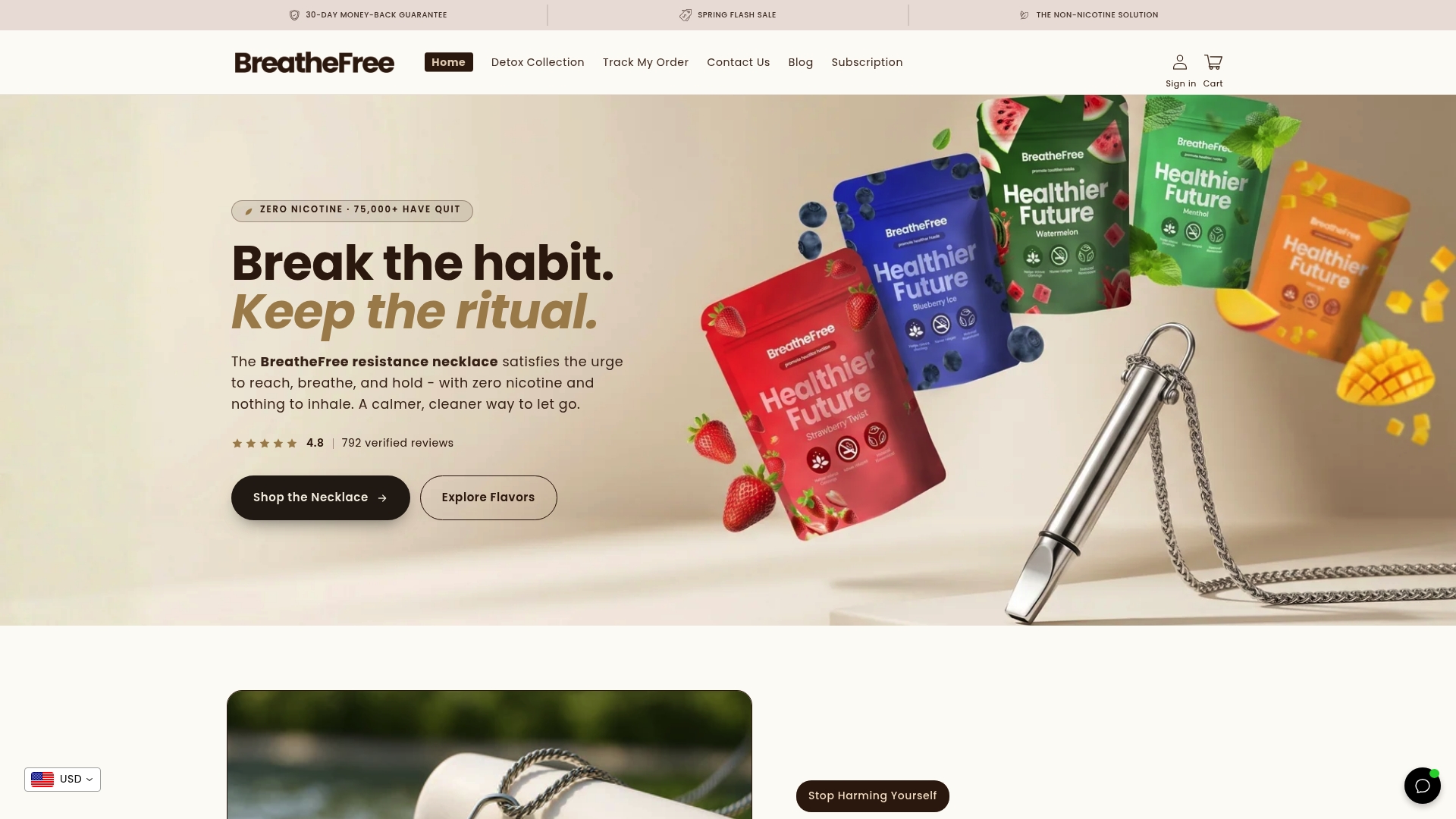
- The resistance necklace and flavor refills are sold separately or as a set.
- A subscription option is available for refills to be delivered on a schedule instead of reordering manually.
- Every order carries a 30-day money-back guarantee, so testing a new flavor family carries little downside.
Start with the flavor refill collection and pick two contrasting profiles to run through your own 7-day test.
FAQ
Is there one flavor that works best for everyone quitting nicotine?
No single flavor works for everyone. The National Cancer Institute’s guidance points toward trigger planning and oral substitution generally, not one specific flavor, so testing a few contrasting options over a week is the more reliable path.
Should I pick a flavor refill that matches my old cigarette or vape flavor?
Generally, no. Research on flavor chemicals and nicotine reward pathways found that menthol and some fruit flavorants can act as conditioned cues that reinforce old use patterns, so a contrasting, novel flavor is usually the safer starting point.
Can a flavor refill replace nicotine gum or a patch?
No. Flavor refills provide mouth occupation and ritual but do not deliver nicotine, while the CDC notes that nicotine medicines work pharmacologically and are recommended alongside or instead of behavioral tools for moderate to high dependence. The two approaches work well together rather than as substitutes for one another.
How long should I test a flavor before deciding it isn’t working?
A seven-day trial per flavor, with daily urge tracking, is usually enough to see whether it is helping. If your logged urge scores are not dropping after a week, rotate to a different flavor family instead of continuing with one that shows no effect.
Does BreatheFree’s resistance necklace deliver any nicotine?
No. BreatheFree’s resistance necklace and flavor refills are completely nicotine-free, designed to satisfy oral fixation and ritual rather than deliver any substance, and the product line carries a 30-day money-back guarantee.
Sources
- Tips for coping with nicotine withdrawal and triggers - National Cancer Institute
- How to use quit smoking medicines - CDC
- The impact of ENDS flavors on nicotinic receptors and nicotine addiction-related behaviors - PMC