

You can quit smoking when your partner smokes, and the plan works best when it does not depend on them. Combine a quit aid with behavioral support, following CDC withdrawal guidance and Smokefree.gov relationship tips. Set smoke-free spaces, call a quitline, and pack a craving kit. We offer BreatheFree as a nicotine-free oral-fixation tool alongside it.
TL;DR:
- Ask your partner to smoke outside, store cigarettes out of sight, and never offer one; agree calmly, since nagging can increase stress and relapse risk.
- A patch can ease baseline withdrawal, while gum or lozenges can address sudden cravings; pair medication with counseling or quitline support for coping and accountability.
- Cravings typically last a few minutes, so leave the smoking area, take ten slow breaths, then walk or sip cold water until the urge passes.
- Seek immediate professional help for severe depression, hopelessness, or thoughts of harming yourself; repeated relapse or unmanageable withdrawal also warrants clinical support.
Table of Contents
- What should you do first when your partner still smokes?
- How do you survive cravings when smoke is nearby?
- How do you set household rules without starting a fight?
- What should a partner-proof quit plan include?
- How do you replace the smoke breaks you used to share?
- When should you get extra help?
- How does a smoking partner affect your mind during a quit attempt?
- How do you build your own motivation when your partner still smokes?
- What are realistic expectations when you quit next to a smoker?
- Where can you find community support for this specific challenge?
- What I tell people quitting beside a smoker
- A nicotine-free way to keep your mouth and hands busy while you quit
- FAQ
- Sources
What should you do first when your partner still smokes?
Start with this short list and work down it in order. Each item takes minutes, and together they cover the home, your cravings, and your support.
- Ask your partner for three concrete things: smoke outside, keep cigarettes in a closed box out of sight, and never offer you one.
- Choose a quit aid and sign up for a quitline or digital support program this week.
- Build a craving kit: gum or lozenges, a water bottle, a written list of three distraction moves, and one oral-fixation item.
- Pick small rewards for day one, day three, and day seven.
- Write a fallback routine for the moments your partner smokes inside, such as leaving the room, stepping out for a walk, or calling a friend.
Pro Tip: Tape the three-item distraction list to the fridge or the inside of your wallet, so it is in front of you when a craving hits and your willpower is thin.
How do you survive cravings when smoke is nearby?
Cravings are cue-driven, which is why a partner lighting up at the table or on the porch hits so hard. Smokefree that urges typically last only a few minutes and that preparing distraction strategies, and considering nicotine replacement, helps you get through them. Your usual cues, like meals, coffee, and the route to the smoking spot, deserve a plan of their own.
Smokefree.gov notes that a craving typically lasts only a few minutes, so your job is to outlast one urge at a time.
When an urge hits, try these:
- Change location right away, especially if cigarettes or smoke are visible.
- Take 10 slow, deep breaths.
- Take a short walk, then sip cold water.
- Chew gum or let a lozenge dissolve, or use your short-acting nicotine replacement if you are already on a plan.
- Ask your partner to store lighters and packs out of sight, and leave the room while they smoke.
Experienced quitters often carry a craving survival kit with an oral-fixation tool in it, because giving your mouth and hands a job interrupts the habit loop. For a deeper look at what drives an urge, see our guide on what a nicotine craving is and how to cope.
How do you set household rules without starting a fight?
Specific requests land better than general complaints. Smokefree.gov guidance on relationships describes an involved, supportive pattern as the most helpful and warns that criticism or nagging raises stress and relapse risk. A meta-analysis of partner support points the same way: the best outcomes tied to interventions that increased supportive behaviors and minimized criticism.
Try a neutral script: “I’m quitting, and it would help if you smoked outside and kept your cigarettes in a closed box. Can we agree to try that?”
- Pick a calm moment, not mid-craving or mid-argument.
- Ask for one or two behaviors, not a lifestyle overhaul.
- Share progress without judgment: “The mornings are getting easier.”
- Plan one shared non-smoking ritual, like an evening walk or a cooking night.
If your partner is not ready to quit, set goals that belong only to you. Your quit date, your aids, and your rewards do not need their sign-off.
Pro Tip: Agree on the rules in advance, and write them down together. A pre-agreed boundary feels like a plan, not an accusation, and it stops unintentional sabotage.
What should a partner-proof quit plan include?
A good plan stands on its own. CDC guidance recommends pairing quit-smoking medicines with behavioral strategies, and Smokefree.gov suggests combining short-acting and long-acting nicotine replacement to handle both baseline withdrawal and sudden urges.
- Nicotine replacement: the patch gives steady background relief, while gum or lozenges cover sudden spikes.
- Prescription options: a clinician can tell you whether a medication suits your health history and what side effects to expect.
- Counseling and quitlines: these add accountability and coping skills on top of medication.
- Your first call: dial 1-800-QUIT-NOW, and have your smoking history, past quit attempts, and current medications ready.
Our quitting action plan guide walks through turning those pieces into a daily schedule. The goal is a setup that still works on the day your partner lights up beside you.
How do you replace the smoke breaks you used to share?
Rituals are half the habit. Swap each one for something with a clear start and finish:
- Take a two-minute walk around the block at the usual smoke-break time.
- Brew a new drink, like herbal tea or sparkling water with lime, and make it a ritual.
- Do a mini chore, like wiping the counter or watering plants.
- Stretch your shoulders and neck for a short while.
Keep your hands and mouth busy with gum, mints, a toothpick, or a flavored nasal stick. At parties, stand with the nonsmokers and plan an exit in advance. With your partner, try a shared post-dinner walk or a new game night. More swaps live in our guides on replacing smoke breaks at work and replacing your smoking ritual.
When should you get extra help?
Most withdrawal fades, but some signs call for a professional right away.
- Severe depression, hopelessness, or any thoughts of self-harm: contact a clinician or emergency services immediately.
- Withdrawal you cannot control even with a plan in place.
- Repeated relapses despite sincere effort.
For next steps, call 1-800-QUIT-NOW, book a primary care visit to discuss prescriptions, or look for a specialized cessation program. Before you call, note how much and when you smoke, what you have tried before, and which medications you take. Irritability that feels unmanageable is common early on, and our irritability plan can help you through it.
How does a smoking partner affect your mind during a quit attempt?
The effect is not only about willpower. Living with a smoker means constant cues: the smell on clothes, the lighter on the counter, the invitation to “just come out for a minute.” In the ARIC study, having a spouse who was a current smoker was associated with significantly lower odds of quitting, with odds ratios of 0.37 for men and 0.54 for women. That is a real headwind, and knowing it exists is useful.
It also stirs up feelings that have nothing to do with nicotine. You may feel resentful that your partner gets to smoke while you struggle, or guilty about being irritable. You may worry that quitting changes the relationship, especially if smoking was a shared break. All of that is normal, and none of it means you are failing.
Name the feeling instead of acting on it. “I’m cranky because I’m craving, not because of you” is a sentence that defuses a lot of arguments. Then return to your tools: the breathing, the kit, the walk. The goal is to separate your partner’s habit from your decision, so their smoking becomes background noise you have a plan for rather than a verdict on your quit.
How do you build your own motivation when your partner still smokes?
Motivation that depends on your partner is fragile. Build reasons that are yours alone, and make them visible. Write down three of them: your breathing on stairs, your money, your kids or family, your mornings without a cough. Put the list where you will see it during a craving.
Track something concrete. A habit tracker, a jar for the money you would have spent, or a calendar with each smoke-free day crossed off turns an abstract goal into daily proof. Small wins matter, because early milestones are the hardest to reach and the easiest to quit on.
Reframe the daily exposure as practice rather than punishment by adding key antioxidants for smokers to support your body’s defenses. Every time your partner smokes and you do not, you strengthen the skill you will need for the rest of your life, since cues will always exist somewhere. Many people find that handling a cue at home first makes the world outside feel manageable.
Lastly, borrow motivation when yours runs low. Read stories from people who quit, call the quitline on a rough day, or message a friend. Research on partner support suggests that boosting partner support alone does not reliably raise quit rates, which is a good reminder: your plan carries the weight, and support is a bonus.
What are realistic expectations when you quit next to a smoker?
Expect it to be harder than quitting alone, and plan for that without taking it as a sign of weakness. Withdrawal symptoms are common but short-lived, and CDC guidance notes they peak early and fade over time. Withdrawal can bring irritability, restlessness, and strong cravings, with symptoms easing over time even if the cues remain.
Expect your partner to be imperfect. They may forget the rule, smoke inside once, or make a thoughtless joke. Treating a partner as a flawless support system sets you both up to fail. Agree on boundaries ahead of time, and when one is crossed, restate it calmly rather than treating it as betrayal.
Expect slips to be possible, and decide in advance what a slip means. One cigarette does not erase your progress. Ask what triggered it, adjust your plan, and restart the same day. People who treat a slip as information tend to recover faster than those who treat it as proof they cannot quit.
Finally, expect your partner’s smoking to come up in the relationship. You might eventually talk about their own quit, but pressure rarely helps. Offer an open door instead: “If you ever want to try it together, I’ll help.” That keeps your quit protected and the relationship intact.

Where can you find community support for this specific challenge?
Peers who understand a mixed household can say what friends who never smoked cannot. Look for quit groups, online forums, or text programs where “my partner still smokes” is a normal thing to type at midnight. Smokefree.gov points to building a support network as part of a quit plan, and the best networks include several kinds of people rather than just one.
Mix your supports. A quitline counselor can help with strategy, a friend who has quit can offer a reality check, and a family member can handle practical help like taking over the evening dishes during a craving window. If your partner will not be part of it, that is fine, because you have other places to turn.
Use the community for specific moments. Post when your partner lights up on the balcony and you are holding on, or when a stressful day makes the old routine loud. Hearing “I did that last week, here’s what worked” is worth more than generic advice.
Our own community of people quitting is part of what we offer. Whatever group you pick, show up regularly, share your wins as well as your struggles, and pass along what worked once you have a few weeks behind you.

What I tell people quitting beside a smoker
Quitting next to a smoker is emotionally messy, and it is still doable. The people who get through it stack their supports: a real quit plan, clear household boundaries, and small daily tactics that interrupt each craving. Do not wait for your partner to change before you start. Try a nicotine-free oral-fixation tool as an extra layer, and use our resources to map your first week.
— Tommy
A nicotine-free way to keep your mouth and hands busy while you quit
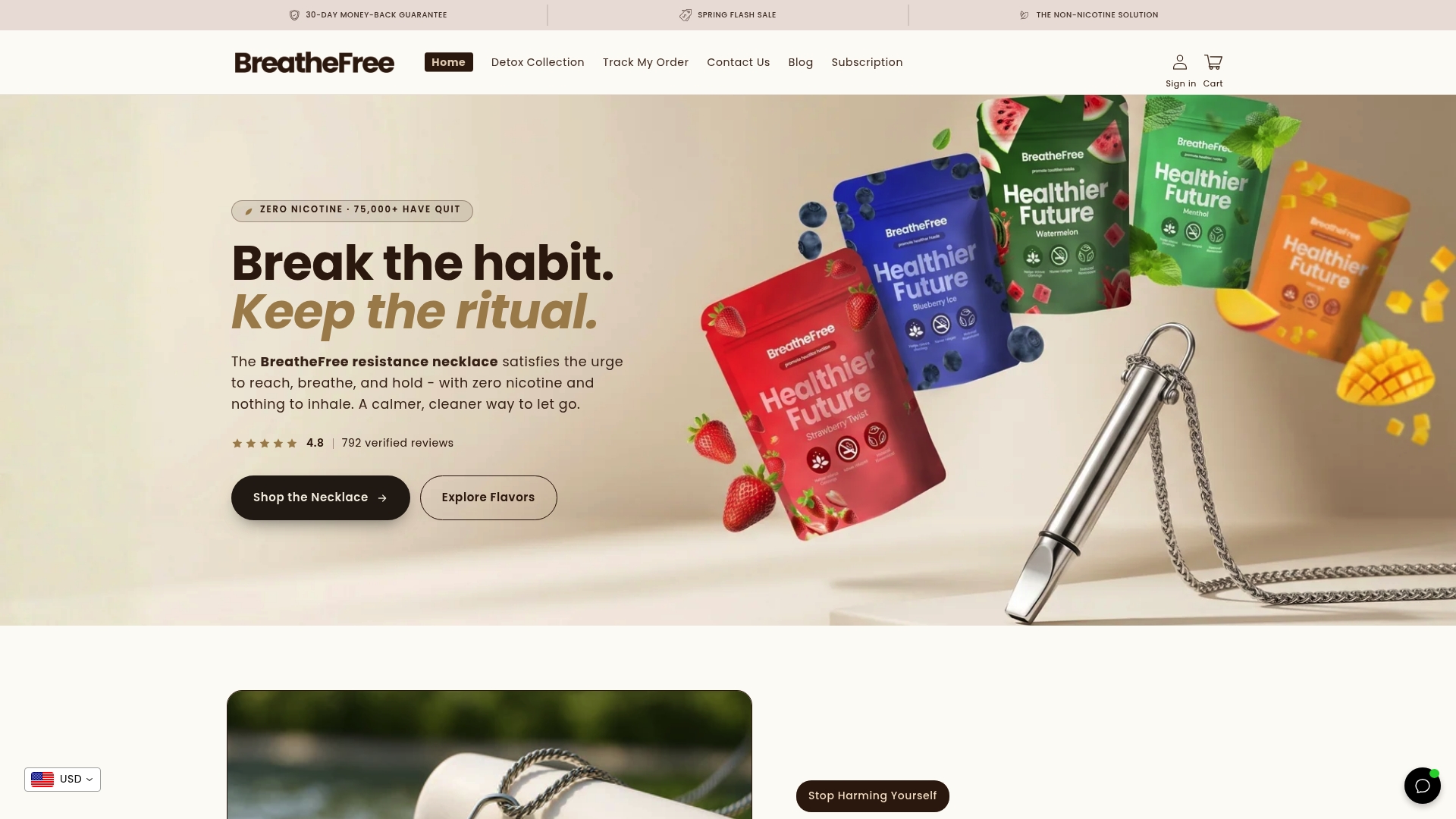
When your partner lights up, the hardest part is often the empty hands and mouth. We make the BreatheFree Resistance Necklace to fill that gap: it is nicotine-free, made of plant fiber, and you hold and draw on it to replace the ritual without inhaling smoke. Flavor refills add variety, and our community is there when a day gets rough. We back every order with a 30-day money-back guarantee. We do not claim it replaces a medical plan, so use it alongside your quitline and any medication. See the necklace at $39.95 and refills at $29.95 in our full collection, or look at our subscription option.
This article is general information, not a substitute for advice from a qualified doctor. Consult a qualified healthcare professional about your own circumstances before acting on anything here.
FAQ
What is the 3-3-3 rule for quitting smoking?
The 3-3-3 rule is a popular informal milestone idea, not a clinical standard, and definitions vary. A common version describes the first three days as the hardest for withdrawal, with things easing over the following weeks. CDC guidance confirms that withdrawal symptoms peak early and fade over time.
What should you do if your partner smokes?
Ask for specific changes like smoking outside and storing cigarettes out of sight, and keep your own quit plan independent of theirs. Smokefree.gov recommends clear, pre-agreed boundaries and warns that nagging increases stress. Offer to help them quit later, but do not make your progress depend on it.
Is it okay to break up with a partner over smoking?
That is a personal decision, and nothing in the research says you must. Most people find that clear boundaries, a solid quit plan, and honest conversation address the daily friction first. If smoking reflects deeper conflict or disrespect of your boundaries, talking with a counselor can help you decide.
How do you quit smoking when you love smoking?
Start by acknowledging that you enjoy it, then replace the specific rituals rather than only the nicotine. Combine a quit aid with behavioral support, as CDC guidance recommends. Give each smoke break a new ritual, such as a walk, a favorite drink, or an oral-fixation tool, so the pleasure has somewhere else to land.
Sources
- 7 Common Withdrawal Symptoms | Quit Smoking | Tips From Former Smokers | CDC
- Managing Nicotine Withdrawal | Smokefree
- Does Enhancing Partner Support and Interaction Improve Smoking Cessation? A Meta-Analysis