

Secondhand smoke residue, known in scientific literature as thirdhand smoke, is the toxic chemical mixture that clings to surfaces, settles into dust, and embeds in fabrics long after visible smoke has cleared. The single most effective thing you can do right now: make every indoor space you control strictly smoke-free and vape-free, permanently.
Why does this matter so urgently? Because the residue does not simply fade. It persists for months to years, chemically transforms into new hazardous compounds, and poses the greatest risk to the people who spend the most time on floors and touching surfaces: infants and young children.
Key facts at a glance:
- Residue accumulates on walls, carpets, furniture, clothing, skin, and HVAC systems
- Children face higher exposure through hand-to-mouth contact with contaminated surfaces
- Ventilation and airing out a room reduce odor but do not eliminate deep chemical reservoirs
- Strict smoke-free policies remain the only consistently reliable prevention
Key Takeaways
Secondhand smoke residue persists on surfaces for months to years, chemically transforms into new toxicants over time, and poses the greatest risk to infants and young children through inhalation, skin contact, and hand-to-mouth ingestion.
| Point | Details |
|---|---|
| Residue persists long-term | Thirdhand smoke is detectable months to years after indoor smoking stops, per systematic review data. |
| Chemical aging increases hazard | Nicotine reacts with indoor ozone and nitrous acid to form TSNAs, compounds that can be more toxic than original smoke constituents. |
| Children face the highest risk | Hand-to-mouth behavior and floor time make infants and toddlers the most exposed group in contaminated homes. |
| Ventilation is not remediation | Opening windows reduces odor but does not remove chemicals embedded in porous materials like carpet and drywall. |
| Breathefree supports quitting | Breathefree’s non-nicotine necklace and habit tracker address the behavioral side of quitting, stopping new residue at the source. |
Table of Contents
- What is secondhand smoke residue, and how does it differ from secondhand smoke?
- Which chemicals make up the residue, and how does it form?
- How long does smoke residue actually persist indoors?
- How are people exposed to smoke residue?
- What does the science say about health risks from smoke residue?
- How to reduce or remove smoke residue from your home
- Can smelling residue make you sick, and when should you see a doctor?
- What experts emphasize and common misconceptions about residue
- Why the “just smoke outside” solution is not enough
- Quitting stops future residue before it starts
- Sources
What is secondhand smoke residue, and how does it differ from secondhand smoke?
Secondhand smoke is the mixture of sidestream smoke from the burning end of a cigarette and mainstream smoke exhaled by the smoker. When that airborne mixture disperses, it does not disappear. The chemicals settle. What remains on every surface the smoke touched is what researchers call thirdhand smoke, or secondhand smoke residue.
Mayo Clinic defines thirdhand smoke as the chemical residue left on surfaces and in dust after tobacco smoke clears, including nicotine and other toxic chemicals that coat walls, floors, furniture, clothing, skin, and hair. The distinction from secondhand smoke matters because the exposure routes and the timeline of risk are completely different.
Where residue accumulates:
- Walls, ceilings, and painted surfaces
- Carpets, rugs, and carpet padding
- Upholstered furniture and mattresses
- Clothing, hair, and skin
- Dust particles throughout the room
- HVAC ducts and filters
| Feature | Secondhand smoke | Thirdhand smoke (residue) |
|---|---|---|
| Source | Burning tobacco and exhaled smoke | Settled chemicals from secondhand smoke |
| Primary exposure routes | Inhalation of airborne smoke | Inhalation of re-emitted gases, skin contact, ingestion |
| Typical persistence | Minutes to hours in ventilated air | Months to years on surfaces and in dust |
Secondhand smoke is the precursor. Every episode of indoor smoking adds another layer of residue to the surfaces around it.
Which chemicals make up the residue, and how does it form?
The chemical profile of tobacco residue is not a simple list of familiar pollutants. It starts with what smoke deposits and then grows more complex as those deposits age.
Key chemicals found in thirdhand smoke:
- Nicotine: The primary tracer compound researchers use to measure residue levels; it adsorbs readily onto surfaces and serves as a reactant for secondary toxicant formation
- Tobacco-specific nitrosamines (TSNAs): Including NNK and NNA, formed when nicotine reacts with indoor nitrous acid and ozone; classified as probable or known carcinogens
- Formaldehyde: A known carcinogen present in fresh smoke that also forms through secondary chemical reactions indoors
- Polycyclic aromatic hydrocarbons (PAHs): Combustion byproducts that bind tightly to dust and surfaces
- Volatile organic compounds (VOCs): Re-emitted from surfaces over time, contributing to indoor air contamination long after smoking stops
The formation process follows a predictable sequence:
- Emission: Tobacco combustion releases thousands of chemicals into indoor air as gases and fine particles
- Sorption: Chemicals adsorb onto surfaces and absorb into porous materials like carpet fibers, drywall, and upholstery
- Chemical aging: Deposited nicotine and other compounds react with indoor oxidants, particularly ozone and nitrous acid, generating secondary toxicants including TSNAs that were not present in the original smoke
- Re-emission: Aged chemicals off-gas back into indoor air or transfer to skin and clothing on contact, creating ongoing exposure even in rooms where no one has smoked in months
Researchers emphasize that the aging step is what makes residue more than a simple deposit problem. Yale Medicine notes that nicotine reacts with indoor oxidants to form tobacco-specific nitrosamines, compounds that can be more hazardous than some of the original smoke constituents. The evidence on the full scope of secondary toxicant formation is still developing, and researchers continue to identify new reaction products.
How long does smoke residue actually persist indoors?
Longer than most people expect. A systematic review and meta-analysis published in Nature found that thirdhand smoke residue is highly persistent in indoor environments and can be detected months to years after indoor smoking has stopped. The same review identified many tobacco-related compounds in residue and proposed reference surface-nicotine levels to help assess contamination.
Persistence finding: Field studies documented surface nicotine and other thirdhand smoke markers across hundreds of homes, and THS markers were found on the hands of most young children in some study samples, even in homes where parents reported no recent indoor smoking.
Several factors determine how long residue lingers in a specific space:
- Material porosity: Porous materials like carpet padding, mattresses, insulation, and drywall absorb chemicals deeply and re-emit them slowly over years; nonporous surfaces like glass and sealed tile hold less and clean more completely
- Indoor chemistry: Higher ozone or nitrous acid concentrations accelerate the formation of secondary toxicants, changing the residue’s composition over time
- Smoking intensity and history: Years of heavy indoor smoking create layered deposits that no single cleaning effort can fully address
- Cleaning history: Regular surface cleaning removes some contaminants from hard surfaces but rarely reaches embedded reservoirs in porous materials
- Ventilation patterns: Opening windows reduces airborne re-emission temporarily but does not extract chemicals already bound into surfaces
Detection of residue on children’s hands and in household dust confirms that the contamination moves. It does not stay fixed to the wall where it first settled.
How are people exposed to smoke residue?
Exposure happens through three distinct routes, and children are vulnerable to all three simultaneously.
Primary exposure pathways:
- Inhalation: Re-emitted gases and fine particles from contaminated surfaces return to indoor air, particularly when surfaces are disturbed or temperatures rise; inhalation of these re-suspended pollutants carries the same class of toxicants as direct smoke exposure
- Dermal absorption: Skin contact with contaminated surfaces, clothing, or another person’s hair and skin transfers chemicals directly; this route is often overlooked because it produces no visible sign of exposure
- Ingestion: Infants and toddlers touch contaminated floors, toys, and furniture constantly and then put their hands in their mouths; this hand-to-mouth pathway delivers residue directly into the digestive system
Residue also travels. Yale Medicine explains that thirdhand smoke adheres to clothing, hair, and skin and can be transported into spaces that have never had a cigarette lit in them, including hotel rooms, workplaces, and the homes of nonsmokers. A grandparent who smokes outdoors but then holds a baby is transferring residue through clothing and skin contact.
The CDC confirms there is no safe level of exposure to tobacco smoke, and that infants and young children face higher risk because of the time they spend indoors and their frequent hand-to-mouth behaviors.
Pro Tip: After visiting a home where someone smokes, remove your shoes at the door, change your outer clothing before holding an infant, and launder those clothes promptly. These three steps cut the residue you carry in by a significant margin.
What does the science say about health risks from smoke residue?
The evidence base for secondhand smoke harm is extensive and unambiguous. For thirdhand smoke specifically, the science is younger but the signals are consistent enough that major public-health bodies treat it as a genuine hazard.
An umbrella review published in Nature Human Behaviour integrating epidemiological evidence found that secondhand smoke exposure is associated with substantial global health burden, citing Global Burden of Disease estimates linking secondhand smoke to approximately 1.29 million deaths and 34.9 million disability-adjusted life years in 2019. That figure reflects airborne secondhand smoke exposure; thirdhand smoke adds a persistent, lower-level exposure layer on top of it.
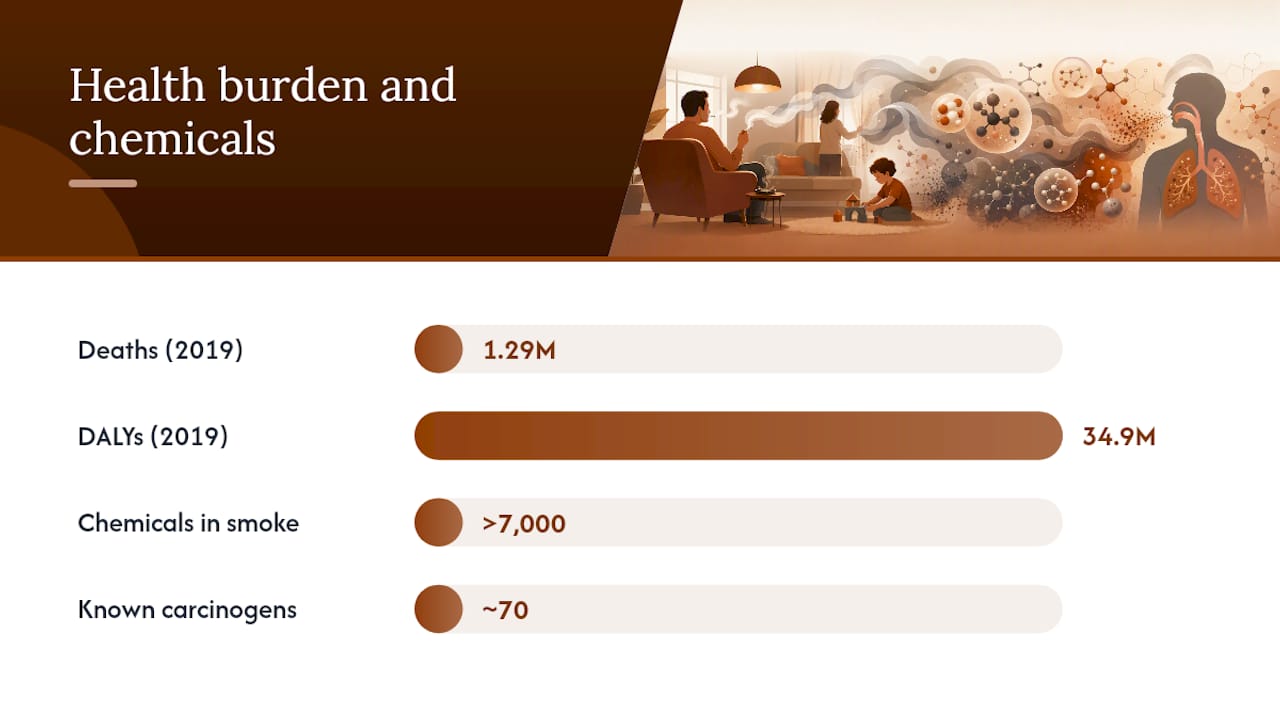
Secondhand smoke contains more than 7,000 chemicals, hundreds of them toxic and about 70 known to cause cancer. Many of those same chemicals are present in surface residue.
Groups most vulnerable to residue exposure:
- Infants and toddlers: Spend hours on floors, mouth objects constantly, and have developing organ systems with less capacity to detoxify chemical exposures
- Pregnant people: Fetal exposure to tobacco toxicants is associated with adverse birth outcomes; residue extends the exposure window beyond active smoking episodes
- People with asthma or other respiratory conditions: Re-emitted VOCs and particles can trigger exacerbations even at concentrations below those of active smoking
- Older adults with compromised immune function: Reduced capacity to clear inhaled particles and metabolize chemical exposures
Where the evidence has limits: most human studies on thirdhand smoke specifically rely on biomarker data and epidemiological associations rather than controlled exposure trials. Direct causal attribution for specific health outcomes from thirdhand smoke alone, separate from secondhand smoke, remains an active area of research. The toxicological plausibility is strong; the human clinical proof for some outcomes is still accumulating.
How to reduce or remove smoke residue from your home
Realistic expectations matter here. Cleaning helps, but it rarely eliminates residue from a heavily contaminated space. The systematic review in Nature supports what remediation professionals have observed: porous materials retain embedded chemicals that re-emit over long periods, making some cleaning efforts only temporarily effective.
Immediate mitigation steps:
- Stop all indoor smoking and vaping immediately; every additional smoking episode adds another layer
- Launder all clothing, curtains, and washable fabrics on the hottest safe cycle
- Vacuum carpets and upholstered furniture with a HEPA-filter vacuum to capture surface particles
- Wipe hard, nonporous surfaces (glass, sealed tile, countertops) with a damp cloth and a mild cleaning solution
- Replace HVAC filters and clean duct grilles
- Keep children away from heavily contaminated rooms until remediation is complete
When to clean versus when to replace:
- Assess porosity first. Hard, sealed surfaces respond to cleaning. Carpet padding, mattresses, and drywall absorb chemicals at depth and rarely clean out fully.
- Check for persistent off-gassing. If a room still smells strongly of smoke after thorough cleaning, the odor indicates ongoing re-emission from embedded reservoirs.
- Look for visible staining. Yellow-brown nicotine staining on walls and ceilings signals heavy accumulation that surface wiping will not resolve.
- Consider documented contamination history. A home where someone smoked indoors daily for years requires a different approach than one with occasional exposure.
- Decide on replacement or professional remediation. Carpets, mattresses, and heavily stained drywall often need replacement rather than cleaning. Professional remediation services can seal surfaces with specialized primers and replace porous materials, though costs vary widely and no method guarantees complete removal.
Pro Tip: Opening windows reduces the smell of smoke residue but does not extract chemicals already bound into walls, carpets, and furniture. Ventilation is a comfort measure, not a remediation strategy. Porous reservoirs can re-emit for years regardless of airflow.
For a practical checklist of smoke-free alternatives and tools that support the transition away from indoor smoking, Breathefree has compiled resources specifically for people in the quitting process.
Can smelling residue make you sick, and when should you see a doctor?
Yes, re-emitted chemicals from contaminated surfaces can cause symptoms, particularly in sensitive individuals. The concentration is generally lower than during active smoking, but for people with asthma, allergies, or respiratory conditions, even low-level exposure can trigger a response.
Symptoms potentially linked to ongoing residue exposure:
- Eye irritation, watering, or redness after time in a contaminated space
- Nasal congestion or runny nose without an obvious allergic trigger
- Persistent cough or throat irritation, especially in children
- Wheezing or shortness of breath in people with asthma or reactive airway disease
- Headaches that improve when leaving the space
Symptoms that warrant prompt medical attention include new or worsening asthma in a child, unexplained recurrent respiratory infections, or any symptom that consistently appears in one location and resolves elsewhere.
When you see a clinician, bring a clear exposure history:
- The address and type of space (apartment, house, vehicle)
- How long smoking occurred indoors and when it stopped
- Whether children are present and their ages
- Any remediation steps already taken
- How long symptoms have been present and whether they improve away from the space
Pro Tip: Photographs of visible staining, dates of known smoking activity, and notes on any air-quality testing or cleaning attempts give a clinician concrete context. A symptom diary noting where you were and when symptoms appeared or improved is more useful than a general description of “the house smells like smoke.”
What experts emphasize and common misconceptions about residue
The science on thirdhand smoke has moved quickly in the past decade, and several widely held assumptions have not held up.
Myth vs. fact:
- Myth: Airing out a room removes the hazard. Ventilation reduces airborne re-emission temporarily and lowers odor. It does not extract chemicals embedded in carpet padding, drywall, or upholstery. The Nature systematic review confirms that porous reservoirs re-emit over years regardless of ventilation.
- Myth: If you can’t smell smoke, the residue is gone. Odor thresholds for nicotine and many VOCs are higher than the concentrations at which some toxic compounds remain active on surfaces. A room that no longer smells like smoke can still carry measurable contamination.
- Myth: Wiping surfaces solves the problem. Surface wiping removes some contaminants from nonporous materials. It does not reach chemicals absorbed into porous substrates, and it does not stop re-emission from walls and ceilings that have absorbed years of smoke.
- Myth: Thirdhand smoke only affects people who were present during smoking. Yale Medicine’s reporting makes clear that residue travels on clothing and skin, contaminating spaces that have never had a cigarette in them.
Evidence base for this article: The findings here draw on a Nature systematic review and meta-analysis on thirdhand smoke persistence, a Nature Human Behaviour umbrella review on secondhand smoke health burden, authoritative public-health guidance from the CDC and Mayo Clinic, and supplementary sources from MedlinePlus, the National Cancer Institute, and Yale Medicine.
Why the “just smoke outside” solution is not enough
The science here changed my thinking on something I used to consider a reasonable compromise. Smoking outside and then returning indoors still transfers residue on clothing, hair, and skin. Children who are held, hugged, or simply share a couch with someone who smoked outside thirty minutes ago are exposed through dermal contact and inhalation of off-gassing from that person’s clothing.
The social and community benefits of smoke-free living extend well beyond personal health. A smoke-free home protects everyone in it, including guests and children who have no say in the matter. The evidence on persistence makes one thing clear: the only way to stop residue from accumulating is to stop smoking indoors entirely, and the only way to stop transferring it is to stop smoking altogether.
For people actively working to quit, the behavioral challenge of hand-to-mouth habit is real and documented; practical advice on how to reduce smoking with nicotine pouches effectively can support this process. The urge to hold something, to have something in your mouth or hands, does not disappear when the cigarette does. Addressing that specific behavioral need is where tools like physical quit-smoking aids make a practical difference, not as a gimmick, but as a way to redirect a deeply ingrained physical pattern.
The science does not offer a cleaning solution that makes past smoking harmless. What it does offer is a clear path forward: stop the source, and the accumulation stops with it.
Quitting stops future residue before it starts
Every cigarette smoked indoors adds to the chemical load on every surface in that space. Quitting removes the source entirely, which is the one step that actually prevents new residue from forming.

Breathefree offers non-nicotine tools designed for the behavioral side of quitting: the Breathefree Breathing Resistance Necklace addresses the hand-to-mouth habit directly, without any nicotine or inhalation. The Nicotine Detox eBook and Habit Tracker gives you a structured plan for the first weeks, when cravings and irritability peak. Many people have used Breathefree’s approach to break free from the habit. For a personalized medical cessation plan, consult your physician or a licensed cessation counselor. Browse the full range of Breathefree tools and start building your smoke-free home today.
Sources
- What is thirdhand smoke, and why is it a concern?
- About Secondhand Smoke | Smoking and Tobacco Use
- Quantitative reference levels for thirdhand smoke residue from tobacco products in indoor environments: a systematic review and meta-analysis
- What Is Thirdhand Smoke? | News | Yale Medicine
- Secondhand smoke
- Secondhand smoke
- Secondhand smoke exposure and human health: an umbrella review | Nature Human Behaviour
This article is general information, not a substitute for advice from a qualified doctor. Consult a qualified healthcare professional about your own circumstances before acting on anything here.