

The hand-to-mouth gesture keeps happening after you quit because it’s a conditioned sensorimotor habit, not just a nicotine craving. Your brain wired the motion itself, the lip pressure, the hand travel, the pause, as a reward signal, and that wiring survives long after nicotine leaves your bloodstream. Pavlovian-to-instrumental transfer research shows cue-driven seeking behavior doesn’t track with dependence level, and Breathefree built its 12-week quit plan around exactly this gap.
- Right now: Grab a straw, a toothpick, or a resistance necklace and mimic the gesture the next time your hand drifts toward your face.
The gesture, not the nicotine, is often what’s still running the show.
Key Takeaways
The hand-to-mouth gesture persists after quitting because it’s a conditioned sensorimotor habit that operates independently of nicotine, and effective replacement requires matching its physical and sensory qualities rather than just addressing withdrawal.
| Point | Details |
|---|---|
| Gesture outlasts nicotine | Conditioned motor routines can persist for weeks or months after biochemical withdrawal fades. |
| Match sensory feedback | Choose substitutes with real resistance or mouth-feel over passive snacks to avoid trading habits. |
| Placement beats willpower | Pre-staging tools at trigger locations matters more than which specific substitute you pick. |
| Track and taper over 12 weeks | Log daily use and gradually reduce reliance as triggers weaken instead of quitting cold on substitutes. |
| Breathefree fits the gap | The resistance necklace and 12-week habit tracker target the gesture directly, alongside nicotine cessation. |
Table of Contents
- Why Oral Habits Persist After Quitting: The Behavioral Loop
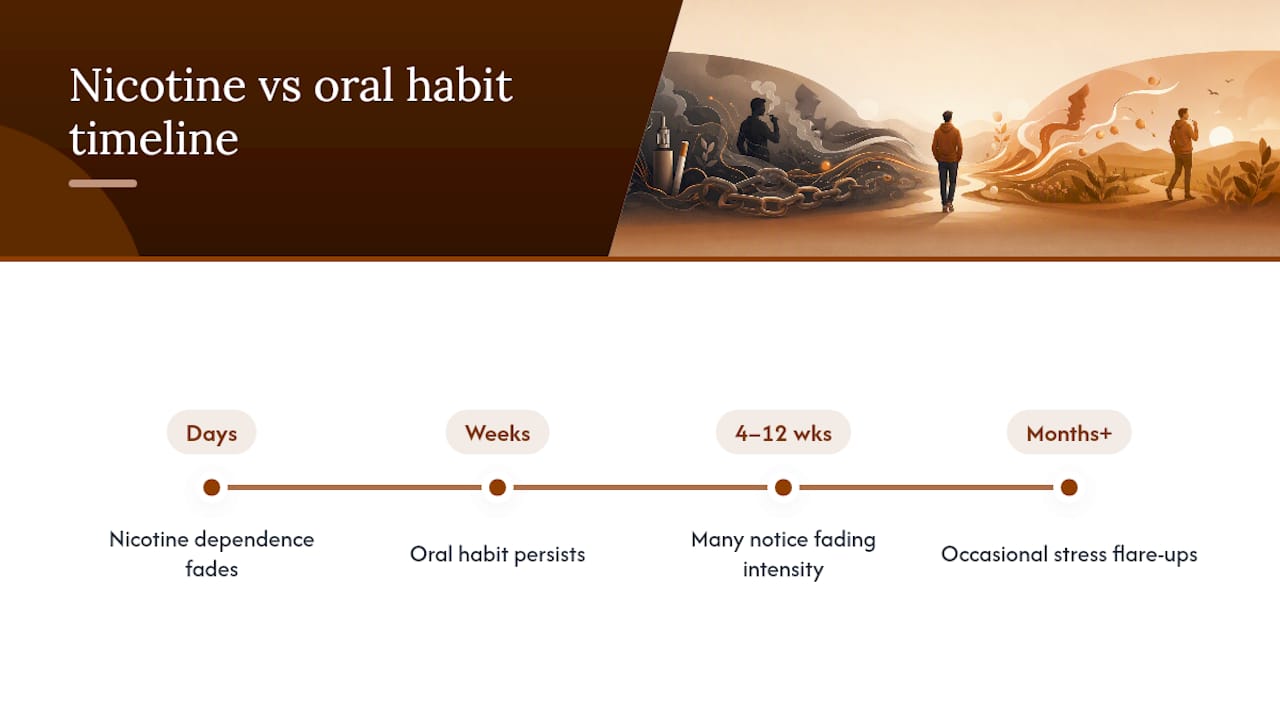
- How Long Do Hand-to-Mouth Urges Last After You Quit?
- What Non-Nicotine Oral Substitutes Actually Work?
- How Do You Build a Habit-Replacement Plan That Sticks?
- What to Do When Oral Substitutes Stop Working
- How Breathefree Supports the Replacement Plan
- Frequently Asked Questions
- Sources
Why Oral Habits Persist After Quitting: The Behavioral Loop
Nicotine withdrawal fades within days. The gesture doesn’t, because it was never purely about the drug. Every time you raised a cigarette or vape to your mouth, you paired a neutral motion (hand up, lips part, inhale) with a reward (nicotine hit, dopamine release, a break from whatever you were doing). Repeat that pairing thousands of times and the motion itself becomes a conditioned stimulus. Your brain learns to expect the payoff from the ritual, not just the chemical.
This is classic Pavlovian conditioning layered onto instrumental learning: the cue (stress, coffee, a phone call) triggers the response (reach for something), which used to deliver the reward (nicotine). Research on smoking-related habit maintenance confirms these behavioral components can sustain a habit independently of nicotine, which is part of why nicotine-only treatments like patches or gum sometimes fail people who still feel restless with empty hands.
There’s also a sensorimotor layer working underneath the psychology. Repeated hand-to-mouth motions get encoded as automatic routines in motor circuitry, similar to how you don’t consciously think about the steps involved in tying your shoes. That automaticity means the gesture can fire with almost no conscious decision behind it. It’s habit at the level of muscle memory, not willpower.
Smoking-related gestures function as ritualized, self-soothing behaviors that operate separately from nicotine dependence itself, according to a 2025 study on gestures and anxiety. People with higher anxiety often lean on the gesture for emotional regulation, regardless of how much nicotine they were actually consuming.
Laboratory conditioning work backs this up further: cues repeatedly paired with smoking can eventually trigger physiological responses on their own, including preparatory lip and mouth muscle activity, before a cigarette even enters the picture. Swap the nicotine out and leave the ritual intact, and you’ve only solved half the problem.
- Cue-response chains form through repetition, not chemistry alone.
- Sensorimotor routines run on near-automatic pilot once established.
- Anxiety can recruit the gesture as a coping tool, separate from cravings.
How Long Do Hand-to-Mouth Urges Last After You Quit?
Nicotine withdrawal and gesture-driven urges run on different clocks, and mixing them up leads to false alarms about relapse.
- First 72 hours: Nicotine withdrawal peaks here (irritability, poor focus). The gesture urge is present but often masked by physical discomfort.
- Weeks 2 to 4: Nicotine symptoms fade fast, but hand-to-mouth urges often get more noticeable because they’re no longer competing with withdrawal.
- Weeks 4 to 12: This is where sensorimotor urges linger for many quitters, tied to specific triggers like driving, drinking coffee, or finishing meals.
- Months out: Urges usually shrink to occasional flare-ups during stress or old routines, rather than constant background noise.
Pro Tip: Stage a replacement tool before you hit a known trigger, not after the urge starts. Waiting until you’re already reaching for your mouth means you’re fighting the habit at its strongest point.
What Non-Nicotine Oral Substitutes Actually Work?
Not every substitute earns its place. Food-based swaps often trade one problem for another, since quitting frequently restores taste and smell, and pairing that with a leftover hand-to-mouth urge is a fast track to snack-driven weight gain. The better strategy targets sensory and mechanical feedback instead of calories.
- Straws: Cheap, portable, and give a decent approximation of the inhale motion. Downside: not very discreet in a meeting.
- Flavored toothpicks: Strong oral resistance, zero calories, easy to carry. Downside: some people find the taste fades fast.
- Sugar-free lozenges or cough drops: Good for sustained mouth engagement. Downside: still involves sucking on something edible, which can slide into habitual snacking.
- Non-nicotine chewing gum: Solid jaw engagement, socially normal almost everywhere. Downside: less effective at replicating the hand-to-mouth travel motion.
- Flavored water with a straw: Hydrating and habit-forming in a good way. Downside: not always practical mid-task.
- Resistance necklace: Gives a tactile, reusable focal point that mimics the resistance and hand-to-mouth motion without anything edible or combustible involved.
The pattern worth noticing: tools that recreate resistance and physical mouth-feel tend to outperform passive snacking, because the nervous system treats the pause itself as a mini regulatory break. A device that requires you to actually manipulate it or breathe through it recreates that pause more convincingly than a handful of chips ever will.
Pro Tip: Rotate two or three substitutes instead of relying on one. Your brain adapts quickly, and variety keeps the replacement from going stale the way a single tool sometimes does.

Breathefree’s resistance necklace was designed around this exact gap, and pairing it with the 12-week habit tracker gives you a way to stage which substitute you’re using and when.
How Do You Build a Habit-Replacement Plan That Sticks?
A substitute sitting in a drawer does nothing. Placement and timing matter more than which specific tool you pick.
- Map your triggers first. Write down the three moments you’re most likely to reach for your mouth (driving, morning coffee, after meals, phone calls).
- Pre-stage replacements at each trigger location. Keep a toothpick in the car cupholder, a necklace on your desk, gum in the kitchen drawer. Successful quitters consistently report that where the tool sits matters more than which tool it is.
- Pick two or three replacements, not ten. Too many options creates decision friction exactly when you need automatic response.
- Pair the swap with a pause ritual. One breath in, one breath out, then reach for the substitute. This recreates the “break” function the cigarette used to serve.
- Log it. A simple daily check mark in a habit tracker shows you which triggers are shrinking and which still need attention.
- Scale down gradually across 12 weeks. Early weeks lean on heavy substitute use; later weeks taper as the gesture naturally weakens.
Removing old cues helps too. If ashtrays, lighters, or a vape charger are still sitting around, nicotine withdrawal symptoms get harder to distinguish from simple visual triggers. Clear the environment, then let the staged substitutes do their job.
What to Do When Oral Substitutes Stop Working
Most stalls trace back to one of three problems. A mismatch between the substitute and the actual sensation you crave (gum instead of something with real resistance), using the tool only during easy moments and skipping the high-stress ones, or letting anxiety-driven urges masquerade as simple boredom.
- Do keep a backup substitute in your bag for stress spikes, not just routine triggers.
- Do pair every swap with a breath and a short pause, since the pause is half the reward.
- Don’t lean on food-only substitutes as your main tool. It solves the gesture and creates a new problem.
- Don’t assume a slip means the plan failed. It means one trigger needs a stronger substitute.
If cravings stay severe past three months, anxiety escalates, or you’ve relapsed more than twice despite consistent substitute use, that’s a signal to bring in outside support. A quitline, a behavioral therapist, or a physician can address what a resistance necklace alone can’t.
Pro Tip: If a specific location keeps beating your substitute (say, the car), double up there with two different tools instead of one. Some triggers need more resistance than others.
A Short Note on Slipping Up
Quitting rarely moves in a straight line. Slips usually teach you which trigger needs a stronger substitute, not that the whole plan failed. Adjust the tool, log it, and keep going.
How Breathefree Supports the Replacement Plan
Everything above points to one conclusion: nicotine withdrawal is temporary, but the gesture needs its own dedicated fix. That’s the entire premise behind the Breathefree resistance necklace, a nicotine-free tool built to give your hand and mouth something real to do, resistance, breathing engagement, a physical object to manage, without a single calorie or chemical involved.
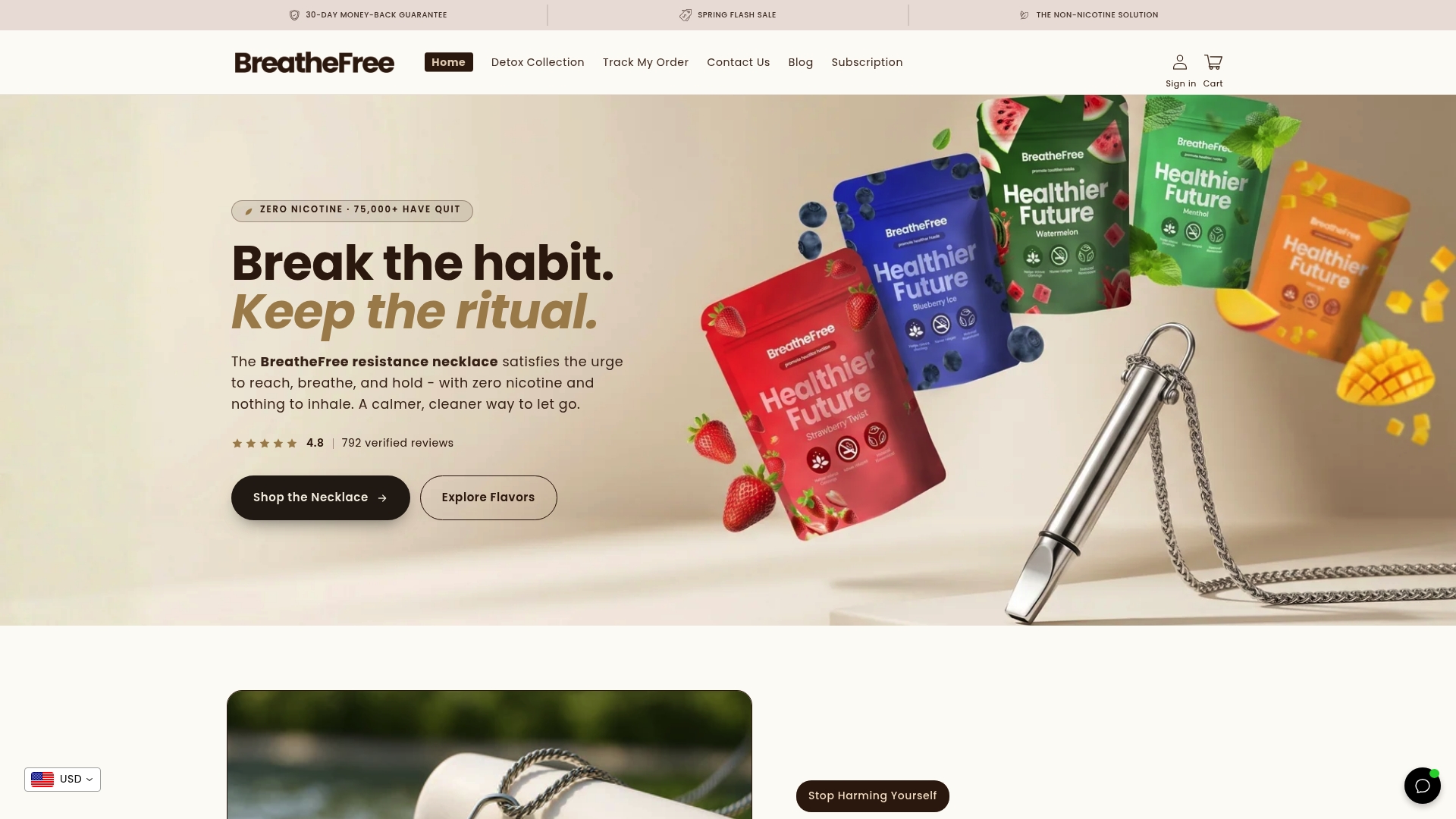
Pair it with the Nicotine Detox eBook & Habit Tracker, and you’ve got the two pieces this article walked through: a substitute that matches the sensory and mechanical qualities of the old gesture, plus a structured 12-week schedule to log triggers, track wins, and taper reliance as the urges shrink. Breathefree’s community has grown past a large community of people using this combination to work through the hand-to-mouth habit directly instead of hoping nicotine cessation handles it alone.
If you’re staging replacements at your desk, in your car, or by your coffee maker, the necklace gives you a focal point to reach for instead of your phone or a snack. Check out the 12-week plan and pick your first two staging locations today.
Frequently Asked Questions
Why do oral habits continue after quitting nicotine entirely? The gesture became a conditioned response through repetition, separate from the chemical dependence, so removing nicotine doesn’t automatically erase the motor routine your brain built around it.
What’s the difference between nicotine dependence and oral fixation? Nicotine dependence is chemical and fades within days. Oral fixation is a learned sensorimotor habit tied to hand movement and mouth sensation, and it can outlast withdrawal by weeks or months.
How do I overcome oral fixation without gaining weight? Pick non-food substitutes that offer real resistance, like a toothpick or a resistance necklace, rather than lozenges or snacks, since taste and smell often return sharply after quitting.
How long does the hand-to-mouth urge typically last? It varies, but many people notice it fading in intensity over 4 to 12 weeks, with occasional flare-ups tied to stress or old routines beyond that window.
What should I do if I slip and go back to my old habit? Treat it as information, not failure. Identify which trigger overpowered your substitute, add a stronger tool there, and log it in your tracker before continuing the plan.
This article is general information, not a substitute for advice from a qualified doctor. Consult a qualified healthcare professional about your own circumstances before acting on anything here.
Sources
- Pavlovian-to-instrumental transfer of nicotine and food cues in deprived cigarette smokers (PMC5896487)
- Smoking-related gestures and anxiety: a preliminary study in treatment-seeking smokers (Frontiers, 2025)