

The technique is simple: breathe in slowly through your nose, then breathe out slowly through the necklace so the exhale runs longer than the inhale. Do that for about a minute, sit tall, keep your shoulders loose, and let the exhale be quiet. This guide covers the exact routine, the mistakes that spoil it, what the research says, and how to use it when a craving hits.
TL;DR
- Inhale through your nose, exhale through the necklace slowly and silently. If you hear a whistle, you are blowing too hard.
- Aim for an exhale longer than your inhale, and practice for at least five minutes in a sitting when you can, since short sessions were less often effective in a 2023 review.
- For a craving, pair the necklace with a simple pattern such as box breathing and give it a few minutes before you decide anything.
- Stop if you feel dizzy or lightheaded, and talk to a clinician first if you have epilepsy, panic disorder, a heart or lung condition, or you are pregnant.
- Our resistance necklace is a nicotine-free oral aid built around the ritual of holding and breathing, with a 30-day money-back guarantee.
Table of Contents
- What a breathing necklace actually asks you to do
- Set up before the first breath
- The basic routine
- Common mistakes and how to fix them
- How long and how often
- Using the technique during a craving
- What the science says about breathing and cravings
- Stay comfortable: safety notes
- Making it a daily ritual
- Where the BreatheFree necklace fits
- FAQ
- Sources
What a breathing necklace actually asks you to do
A breathing necklace is a pendant with a narrow channel. You breathe out through it, and the small opening makes you slow down. The technique has one core idea: a longer, calmer exhale. Everything else (posture, counts, how often you practice) is there to support that.
The reasoning behind it comes from slow-breathing research. A Frontiers in Human Neuroscience paper summarized by a sleep company’s blog describes vagus nerve activity as quieter on the inhale and stronger on the exhale. That is why people who teach this style of breathing focus on making the out-breath unhurried.

A necklace cannot breathe for you. It guides the exhale. The inhale is still yours, so how you sit and where you send the air matters.
Set up before the first breath
Spend ten seconds on the setup. It changes how the whole minute feels.
- Sit or stand tall. Let your spine lengthen without stiffening. Slumping squeezes the belly and pushes you toward shallow chest breathing.
- Drop your shoulders. Lift them to your ears once, then let them fall.
- Rest one hand on your belly. You want to feel it widen on the inhale.
- Bring the mouthpiece to your lips. Place the end just inside your mouth with your lips relaxed around it. No clenching.
- Keep your jaw loose. Tension in the jaw tends to turn into forceful blowing.
If your necklace came with its own instructions, follow those for the mouthpiece itself. The steps here cover the breathing around it.
The basic routine
This is a gentle starter pattern. Count silently in your head and do not chase exact numbers on day one.
- Inhale through your nose for about 4 seconds. Let the air drop low so your belly hand rises before your chest does.
- Pause briefly. A short hold of a few seconds is fine. If holding your breath feels uncomfortable, skip it and go straight to the exhale.
- Exhale through the necklace for 6 to 10 seconds. Slow and steady, like fogging a mirror quietly rather than blowing out a candle.
- Repeat 3 or 4 times. That is roughly a minute.
- Return to normal breathing and notice how your shoulders, jaw and hands feel.
A few signals tell you you are doing it right:
- The exhale is silent. A whistle means you are blowing too hard.
- Your belly softens at the end of each breath.
- You never feel you are running out of air before the exhale ends. If you do, shorten the count.
Do the counts have to be exact?
No. In a 2023 randomized trial, 12 weeks of regular slow breathing significantly reduced psychological stress, yet the ratio of exhale to inhale did not produce a statistically significant extra difference among healthy adults. The practical takeaway: consistency and slowness count more than hitting a precise ratio. Pick a rhythm you can repeat comfortably and do it often.
Common mistakes and how to fix them
| What you notice | What is probably happening | Fix |
|---|---|---|
| A whistling sound | Exhale too forceful | Soften your lips and breathe out as if sighing |
| Lightheaded after a few breaths | Breathing too deeply or too fast | Shorten the inhale, rest, return to normal breathing |
| Chest rises more than belly | Shallow chest breathing | Hand on belly, inhale low through the nose |
| Running out of air mid-exhale | Count too long | Cut the exhale to 5 or 6 seconds and build up |
| Jaw or neck aching | Clenching around the mouthpiece | Relax the jaw, lips only |
| Mind racing | Normal, especially early on | Count the exhale seconds to give your attention a job |
How long and how often
One round of about a minute is a fine start. For lasting benefit, aim higher over time. A 2023 systematic review of breathing practices found that 54 of 72 breathing interventions were effective for stress or anxiety. The effective ones avoided fast-only breathing and sessions shorter than 5 minutes, and they tended to include multiple sessions and long-term practice.
A realistic plan:
- Week 1: one minute, twice a day, at moments when you are not stressed. Learn the feel while it is easy.
- Weeks 2 to 3: extend to three to five minutes once a day, plus quick one-minute rounds when tension shows up.
- From week 4: keep a daily session and use short rounds as needed.
Practicing when you are calm matters. A skill you only try in the middle of a hard moment is much harder to run. A habit tracker makes it easy to see whether the daily session is actually happening.
Using the technique during a craving
Cravings come in waves. The Oklahoma Tobacco Helpline describes urge surfing: find a quiet spot, notice where the craving shows up in your body, and move your attention between your breath and those sensations until the urge passes, typically within 20 to 30 minutes. It also suggests box breathing: inhale for four counts, hold four, exhale four, and repeat.
Here is how to build the necklace into that:
- Name it. Say to yourself, “This is a craving, and it will crest.” Our guide to labeling a craving in 60 seconds helps you tell a stress urge from a habit urge.
- Reach for the necklace. Holding something gives your hands and mouth a job, which is the oral fixation many quitters describe.
- Run three to five slow rounds. Inhale through your nose, exhale slowly through the necklace.
- Check in. Rate the urge from 1 to 10. Repeat for another minute or two if it is still high.
- Ride it out. Keep going, drink water, and move your body if you can. The urge rises, peaks and falls.
If you want a different count to try, we have written scripts for box breathing for cravings, 4-7-8 breathing, nasal breathing and pursed lip breathing. At work, 10 slow breaths is a discreet version.
What the science says about breathing and cravings
The research on slow breathing is encouraging, and it is the foundation for this technique.
- A 2026 review published in Addiction found small but statistically significant reductions in drug cravings from breathing-based interventions, with stronger evidence for immediate relief in a single session.
- A 2019 study of mindfulness-based yogic breathing found it reduced the risk of smoking by more than two-fold compared with a cognitive strategy group and a no-treatment group during a 50-minute smoking choice task. Those in the breathing condition also smoked fewer cigarettes over the next 24 hours.
- A Forbes report from 2021 notes that deep, controlled breathing slows the heart rate, lowers blood pressure and stimulates the parasympathetic “rest-and-digest” system.
These studies look at controlled breathing, which is the skill the necklace is built to make easy to repeat. A physical tool gives you a cue, a rhythm and something to hold.
Stay comfortable: safety notes
For most healthy adults, slow breathing is gentle. The National Center for Complementary and Integrative Health says relaxation techniques are generally considered safe for healthy people, though people occasionally report increased anxiety, intrusive thoughts or a fear of losing control. It also notes rare reports of certain relaxation techniques causing or worsening symptoms in people with epilepsy, certain psychiatric conditions, or a history of abuse or trauma.
A 2026 review in Frontiers in Psychiatry adds specifics:
- Slow, deep breathing can cause brief dizziness or lightheadedness. If that happens, stop, breathe normally and sit until it passes. Next time, shorten the inhale.
- People with epilepsy, panic disorder or a psychotic disorder show greater vulnerability to structured breathing practices. Talk to your doctor or mental health clinician first.
- People with significant cardiovascular, cerebrovascular or respiratory conditions such as COPD should practice under close medical supervision.
- Pregnant people should avoid high-ventilation and breath-hold protocols. Skip the hold in the routine above and ask your obstetric provider before starting.
Never use the necklace while driving, while lying down half asleep, or with anything in the mouthpiece other than its intended use. If you take medication for quitting or have questions about it, your doctor or the free quitline at 1-800-QUIT-NOW can help you plan.
Our take on technique
We built BreatheFree around a simple observation: when people stop smoking, the nicotine is only part of what they miss. The hand-to-mouth motion, the pause, the ritual of taking a break are all missing too. A resistance necklace gives that moment back without smoke, vapor or nicotine.
That is why we care about technique. A slow exhale gives the urge somewhere to go, and a physical object makes the habit easy to repeat in an office, on a flight or in the car after dinner. Our products are solid and plant-fiber based, and we offer natural flavors so the ritual feels like yours.
Our advice is to practice when you are calm, keep it quiet and slow, and reach for the necklace the moment you notice a craving, not twenty minutes later. We say over 75,000 people have used this method to quit, and our community exists so you do not have to do it alone.
Tommy
Making it a daily ritual
The people who get the most from a breathing tool tend to attach it to something they already do. Pick two or three anchors:
- First coffee or tea of the day. Three rounds before the first sip.
- The old smoke break. Same time, same place, but the necklace goes in your hand instead of a cigarette.
- After meals. This is a classic trigger window for many people. Do a three-minute session before you leave the table.
- Before bed. A short session helps you wind down without reaching for your phone.
If you want more tools to stack, read quitting smoking using physical objects, try peppermint for cravings, or work through a 3-minute CBT exercise. Different cravings respond to different fixes, and you will learn which is yours.
Where the BreatheFree necklace fits
If you want a nicotine-free tool designed around the oral fixation side of quitting, our resistance necklace is $39.95, and flavor refills are $29.95. It has no nicotine, no chemicals and no inhalation, and it is made to be used anywhere, including flights and offices. Every order is covered by our 30-day money-back guarantee.
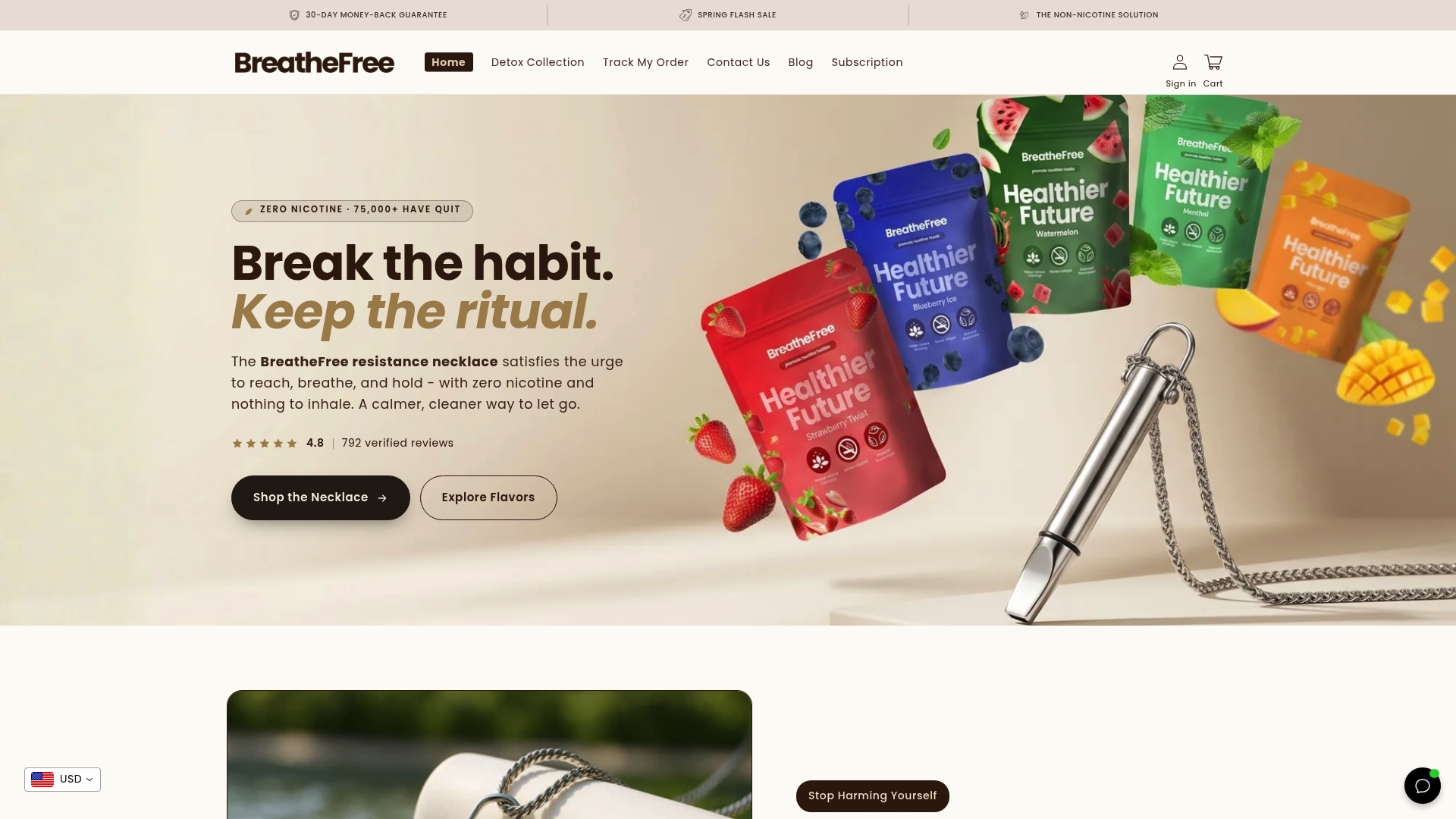
You can see the full range on our collection page, look at the resistance necklace collection, or check the subscription option if you want refills to keep arriving.
FAQ
How do I use a breathing necklace?
Sit tall, inhale slowly through your nose, then exhale gently through the necklace so the out-breath is longer than the in-breath. Repeat three or four times, about a minute in all. Keep the exhale silent: a whistle means you are blowing too hard.
How long should each session last?
Start with one minute and build toward five minutes or more, since the 2023 review found effective programs avoided very short sessions and included regular, long-term practice. Daily practice when you are calm makes the technique easier to use during a craving.
Does the exhale have to be exactly twice the inhale?
No. A longer exhale is a good guide, but in a 2023 trial different exhale-to-inhale ratios did not show a statistically significant difference in stress reduction among healthy adults. Choose a pace that feels smooth and sustainable.
Can I use it when I get a craving?
Yes. Name the craving, take three to five slow rounds, then check how strong the urge is. Reviews of breathing-based methods report small but significant reductions in cravings, strongest right after a single session. Keep going for a few minutes while the wave passes.
Is it safe for everyone?
It is considered safe for most healthy people, but stop if you feel dizzy. If you have epilepsy, panic disorder, a heart or lung condition such as COPD, or you are pregnant, ask your doctor before you begin structured breathing practice.
Sources
- Slow breathing for reducing stress: the effect of extending exhale (PMC, 2023)
- Breathing Practices for Stress and Anxiety Reduction (PMC, 2023)
- Controlled breathing may reduce drug cravings (Addiction, 2026)
- Effects of Mindfulness-Based Yogic Breathing on smoking (PMC, 2019)
- 4 Simple Tips for Staying Tobacco Free (Oklahoma Tobacco Helpline)
- Mind and Body Approaches for Stress and Anxiety (NCCIH, 2024)
- Neurophysiological mechanisms of breathing (Frontiers in Psychiatry, 2026)
- Do Breathing Necklaces Work? (Saatva)
- Wearing Your Therapy (Forbes, 2021)
- Anxiety Necklace and Sleep Guide (Mattress Miracle)