


Most people notice smell and taste starting to return within days to weeks of their last cigarette, but full recovery can take years, and the pace depends mostly on how long and how heavily you smoked. Former smokers in large studies end up with a sense of smell no different from people who never smoked, so the direction is good. What you need is a realistic timeline, a way to get through the odd phase when scents feel too strong or wrong, and a way to keep your hands and mouth busy so the cravings don’t undo the progress. That last part is where our nicotine-free resistance necklace comes in.
TL;DR
- Smell and taste can begin returning within days of quitting. Full recovery to non-smoker levels may take up to 15 years, depending on how long you smoked and other factors.
- Large pooled data show former smokers’ odds of smell problems are no higher than those of people who never smoked, so smoking-related loss appears reversible.
- Scents can seem too strong, off or unpleasant while the nerves regenerate. That is a recognized phase of recovery, and smell training can help.
- See a doctor if reduced smell lingers more than a couple of weeks without an obvious cause, or right away if it vanishes suddenly and severely.
- Protect the progress: cravings are strongest early, and a nicotine-free routine for your hands and mouth makes it easier to stay quit.
Table of Contents
- Why smoking dulls your sense of smell
- A realistic timeline
- What affects how fast it comes back
- When scents feel too strong, or wrong
- When to see a doctor
- Why the cravings matter more than the nose
- Keeping a nicotine-free routine while your senses recover
- A simple plan for the next 90 days
- FAQ
- Sources
Why smoking dulls your sense of smell
Smell works through a small patch of tissue high in your nose, the olfactory epithelium. Odor molecules land on it, and nerve cells send the signal to your brain. Tobacco smoke irritates and changes this tissue. A systematic review of 11 studies describes smoke-related cell changes in the olfactory lining, and the authors point out that this tissue regenerates roughly every 60 to 90 days, which may allow function to come back with continued abstinence.
The exact mechanism is not settled. The American Family Physician’s clinical review says vascular mechanisms may play a role, meaning damage to the small blood vessels that feed the nose and nerves. That would also explain why recovery tracks the slow recovery of blood vessel health in general.
Taste is tied in closely. Cleveland Clinic notes that up to 80% of what we call taste actually comes from smell. When food seems bland after years of smoking, a lot of that is your nose, not your tongue.
A realistic timeline
There is no single date, but the research gives a useful shape. Think in three stages.
| Stage | What studies show | What you may notice |
|---|---|---|
| First days | Cancer Council Australia says taste and smell start to return after about two days | Coffee, food and fresh air smell sharper |
| First weeks to months | A 2020 study found significant gains in odor discrimination and identification just 45 days after quitting | Easier to pick out individual smells; flavors fill in |
| Years | Former smokers who quit more than 15 years earlier did not differ from never smokers in odor identification | Smell testing close to normal |
The early gains
The 45-day study followed 28 volunteers who had smoked for about 25 years on average and around 21 cigarettes a day. Even in that heavy-smoking group, scores improved significantly within a month and a half. The same study found that the longer someone had smoked, the smaller the improvement, so a short history tends to mean a faster, fuller return.
Taste has its own path. A study of taste sensitivity after cessation found recovery on the front of the tongue within about two weeks, the back within about nine weeks, and the middle surface after two months or more. If you want the week-by-week view, we cover it in our guide to how taste changes after quitting.

The long tail
The 15-year figure is the one you will see most often. The American Academy of Family Physicians’ patient page says that after you quit, it may take 15 years for smell to recover fully. It comes from a 2019 study of 3,528 older adults: former smokers who had quit 15 or fewer years earlier still scored lower on odor identification than never smokers, while those who quit longer ago did not.
Read that carefully. It describes older adults, many of whom smoked for decades, measured with a formal test. It does not mean you will go 15 years unable to enjoy a meal. Everyday improvement usually comes far sooner, and a younger person with a shorter smoking history has a different starting point.
The encouraging pooled result
The 2017 review mentioned above combined 11 studies. Current smokers had 59% higher odds of olfactory dysfunction than never smokers. Former smokers showed no significant difference from never smokers. The authors read this as a sign that smoking’s effect on smell may be reversible, and they suggest clinicians tell patients that quitting may improve their sense of smell.
What affects how fast it comes back
- How long you smoked. The 45-day study found improvement was inversely related to years of smoking. Longer history, slower gains.
- Total exposure. A 2025 Swiss study of 375 smokers found smell problems were associated with pack-years (packs per day multiplied by years smoked), not with years or cigarettes per day alone.
- Age and other causes. The AAFP says whether smell returns to normal depends on the cause, severity, age and other factors. Sinus disease is the most common cause of smell and taste disorders in general, and medications, head injury and alcohol dependence can also play a part.
- Staying quit. Regeneration of the smell lining works only if the irritant stays away. A relapse resets the clock, which is why a plan for cravings matters as much as the nose itself.
When scents feel too strong, or wrong
As the nerves come back, the signal can be messy at first. Some former smokers find ordinary smells suddenly overwhelming: cooking, cleaning products, perfume, other people’s smoke. Others notice smells that seem distorted. The international consensus statement on olfaction describes this distortion, called parosmia, as smells often perceived as burned, foul or otherwise unpleasant during olfactory recovery.
It is unsettling, but it is a recognized part of the process rather than a new problem. A few practical steps:
- Go easy on strong triggers. Ventilate while cooking, pick unscented cleaners, and step away from heavy fragrance while your nose recalibrates.
- Start smell training. The AAFP recommends asking your doctor about smell retraining, and its clinical review gives it its top evidence rating for people whose quality of life stays poor because of smell loss.
- Eat for texture and temperature. When flavor is muted, crunchy, creamy, hot and cold foods still register through your mouth and keep meals satisfying.
- Be patient with the gaps. Improvement tends to arrive in uneven steps, not a straight line.
How smell training works
Smell retraining is simple. Harvard Health describes sniffing six to 10 different scents such as lemon, eucalyptus, cinnamon or cloves, once or twice a day, spending 30 seconds to two minutes on each while thinking about what you are smelling and recalling when you last met it. Household items work. Ask your doctor to confirm it fits your situation, especially if your smell loss is more than mild.

When to see a doctor
Smoking is only one cause of smell loss, and you should not assume it explains everything. Cleveland Clinic advises telling a healthcare provider if decreased smell lingers for more than a couple of weeks, and seeking medical care right away if smell disappears suddenly and severely with no apparent reason.
The AFP review adds that patients with stubborn cases, or with depression, poor sleep, dementia, unintentional weight loss or malnutrition, should be referred to an ear, nose and throat specialist for objective testing. Smell loss can lower appetite and mood, so it is worth treating as a real health issue, not a nuisance. Your primary care doctor is the right first call.
Why the cravings matter more than the nose
Here is the catch with smell recovery: it rewards the people who stay quit. Fresh smells and tastes are a real reward in the first weeks, but they arrive at the same time as the strongest cravings and the habit of reaching for something with your hand and mouth. A sharper nose also notices the smell of smoke on a stranger’s jacket or a patio, which can tug at you.
That is the moment relapse tends to happen, and we have written about what causes relapse after quitting. The recovery of your lungs, throat and airways is also gradual, and you may deal with mucus or a lingering cough along the way. Our overview of the lung recovery timeline shows where smell fits among those changes.
What we have learned about the first months
We built BreatheFree around a simple idea: a lot of quitting is about the hand and the mouth, not only the nicotine. When people stop, they lose a ritual, and they need something to put in its place that does not bring nicotine, chemicals or inhalation back into the picture.
That is why our resistance necklace is nicotine-free, solid and plant-fiber based, and designed to give you something to hold and draw on in the moments when a craving hits. It works on a flight, in an office, in the car. Flavor refills let you choose a natural flavor you enjoy, which pairs nicely with a returning sense of taste and smell.
Our community is there for the days that feel long, and more than 75,000 people have told us they have quit using this approach. Better smell and clearer breathing are the rewards that come with staying quit. Our job is to help you stay quit long enough to enjoy them.
Tommy
Keeping a nicotine-free routine while your senses recover
If you want a tool for the craving moments, the BreatheFree Resistance Necklace is $39.95, and Flavor Refills are $29.95. Both are nicotine-free and need no inhalation of anything harmful. Our 30-day money-back guarantee covers your order, and a subscription option is available on our site.
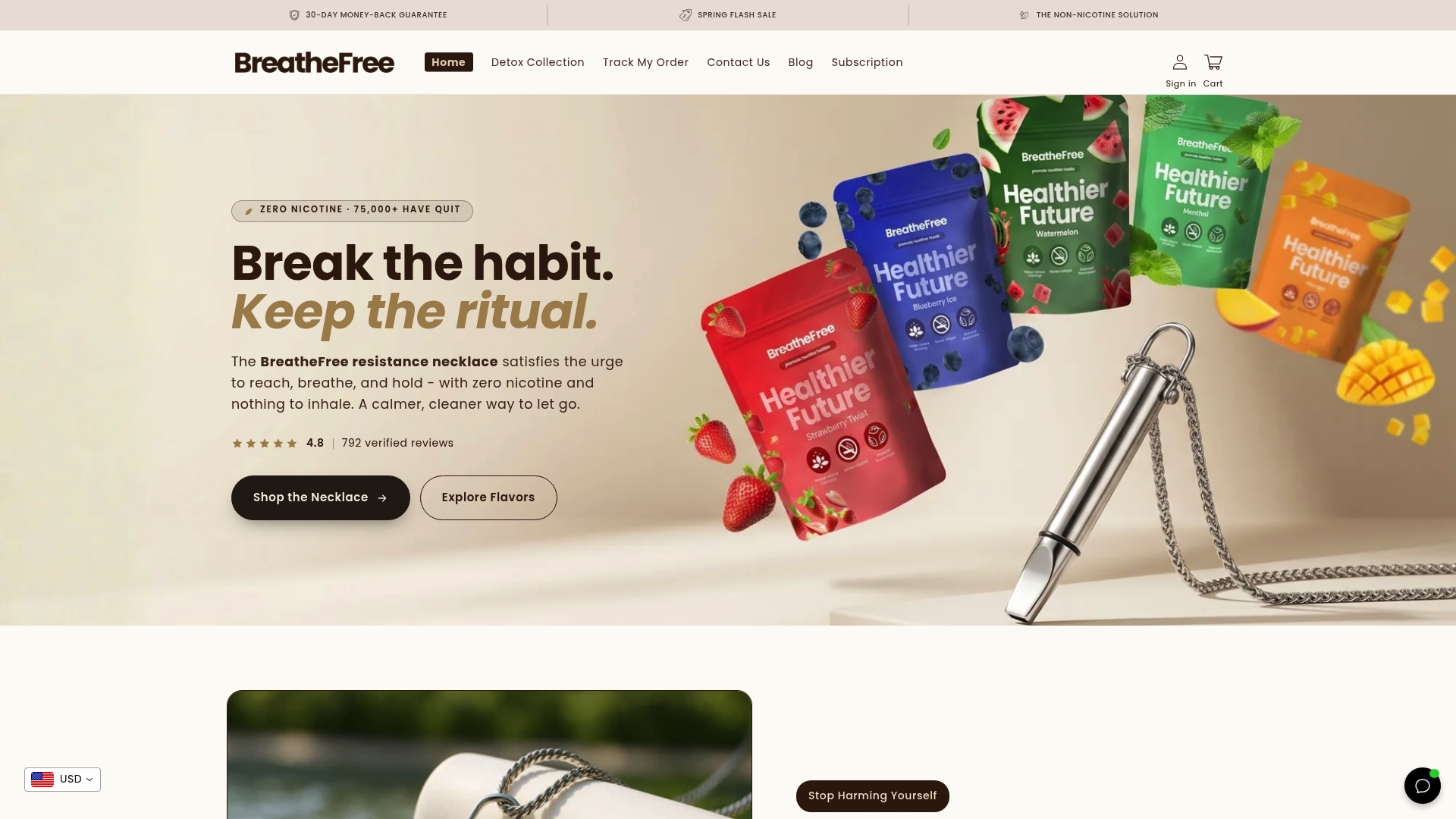
You can see the full range, including the habit tracker for marking each smoke-free day, on the BreatheFree shop page. Many people find that watching the days stack up while their smell and taste return is a strong motivator.
A simple plan for the next 90 days
- Days 1 to 7: Expect cravings and the first flavor changes. Keep your hands and mouth occupied during trigger times such as coffee, after meals and driving.
- Weeks 2 to 6: Start smell training once or twice daily with a handful of household scents. Note which smells come back first.
- Weeks 6 to 12: Parosmia or oversensitivity may show up. Reduce strong triggers, keep training, and book a doctor visit if reduced smell has lingered without a clear cause.
- Beyond: Keep tracking smoke-free days. Subtle gains can continue for years.
Other body changes arrive alongside smell. Our guides to what your body goes through after quitting and why breathing changes explain the rest.
FAQ
How soon will I smell better after I quit smoking?
Many people notice a difference within days. Cancer Council Australia reports that taste and smell start to return after about two days, and a 2020 study found measurable improvement by 45 days. Fuller recovery takes longer and varies from person to person.
Why do smells seem so strong or unpleasant now?
As the smell nerves regenerate, signals can be amplified or distorted for a while. Researchers describe unpleasant or burned-smelling perceptions as part of olfactory recovery. Limiting strong triggers and trying smell training can help, and your doctor can advise if it persists.
Will my sense of smell ever fully return?
The evidence is encouraging. A pooled analysis found former smokers had no significant difference in smell problems compared with never smokers. Formal recovery in older adults has been measured at around 15 years, and individual results depend on how long you smoked and your age.
Does smell recovery affect taste?
Yes. Up to 80% of taste comes from smell, so food often seems more flavorful as your nose recovers. The tongue’s own sensitivity also improves over the first weeks to months.
When should I see a doctor about smell changes?
Tell your healthcare provider if decreased smell lingers for more than a couple of weeks, and get medical care right away if you lose smell suddenly and severely with no obvious reason.
Sources
- Smell and Taste Disorders (AAFP patient information, 2023)
- Smell and Taste Disorders in Primary Care (American Family Physician, 2023)
- Hyposmia: Causes, Symptoms & Treatment (Cleveland Clinic)
- Smoking and Olfactory Dysfunction: a Systematic Literature Review and Meta-Analysis (2017)
- Olfactory dysfunction persists after smoking cessation (2019)
- Smoking cessation improves olfactory functions (2020)
- Association between duration or intensity of tobacco smoking and olfactory dysfunction (2025)
- Effect of cigarette smoke on gustatory sensitivity and recovery after cessation
- Quit smoking (Cancer Council Australia)
- International consensus statement on allergy and rhinology: Olfaction
- Ways to regain your sense of smell (Harvard Health)