

Taste often starts shifting within 48 hours of quitting, as damaged nerve endings and taste cells begin to recover from years of heat and smoke exposure. Most people notice steady improvement over two weeks to several months, though heavy or long-term smokers sometimes take longer to reach a nonsmoker’s baseline. If taste stays flat, metallic, or gets worse past that window, it’s worth a checkup rather than waiting it out.
TL;DR:
- Taste sensitivity often begins to improve within two weeks after quitting smoking, with the tip and edges of the tongue recovering first.
- Full recovery of the dorsal tongue can take eight months or longer, especially for heavy or long-term smokers with higher dependence.
- Factors like smoking history, dependence level, sinus issues, medications, and age influence the speed and extent of taste recovery.
- Persistent taste loss beyond several months or a worsening condition warrants a medical evaluation, including ENT exams or medication review.
- Supporting oral hygiene, reintroducing mild flavors gradually, and using non-nicotine oral tools can enhance recovery and help manage cravings.
Table of Contents
- Taste Changes After Quitting: The Week-by-Week Timeline
- Why Does Smoking Change Taste and Smell in the First Place?
- What Does It Actually Feel Like When Taste Comes Back?
- How Can You Support Your Taste Recovery After Quitting?
- Why Does Appetite and Weight Change After Quitting?
- When Should You See a Doctor About Taste Changes?
- What I’ve Learned About Taste Recovery and Staying Quit
- A Non-Nicotine Tool for the Habit That Outlasts the Craving
- Sources
- FAQ
Taste Changes After Quitting: The Week-by-Week Timeline
Your tongue doesn’t heal all at once. Different taste receptor sites recover on their own schedule, which is why the first week can feel dramatic and the next few weeks can feel like nothing is happening at all.
Within 48 hours, many people already report sharper smell and a noticeable uptick in how food tastes. This lines up with what the CDC lists as a common early withdrawal symptom: smoke no longer coats the tongue and dulls the olfactory signals that make up most of what we perceive as flavor.
By around 2 weeks, the tip and edges of the tongue, the areas that register sweet and salty most strongly, tend to show measurable recovery. A 2017 electrogustometry study, which uses mild electrical stimulation to test taste sensitivity, found this pattern consistently across former smokers being retested over time.
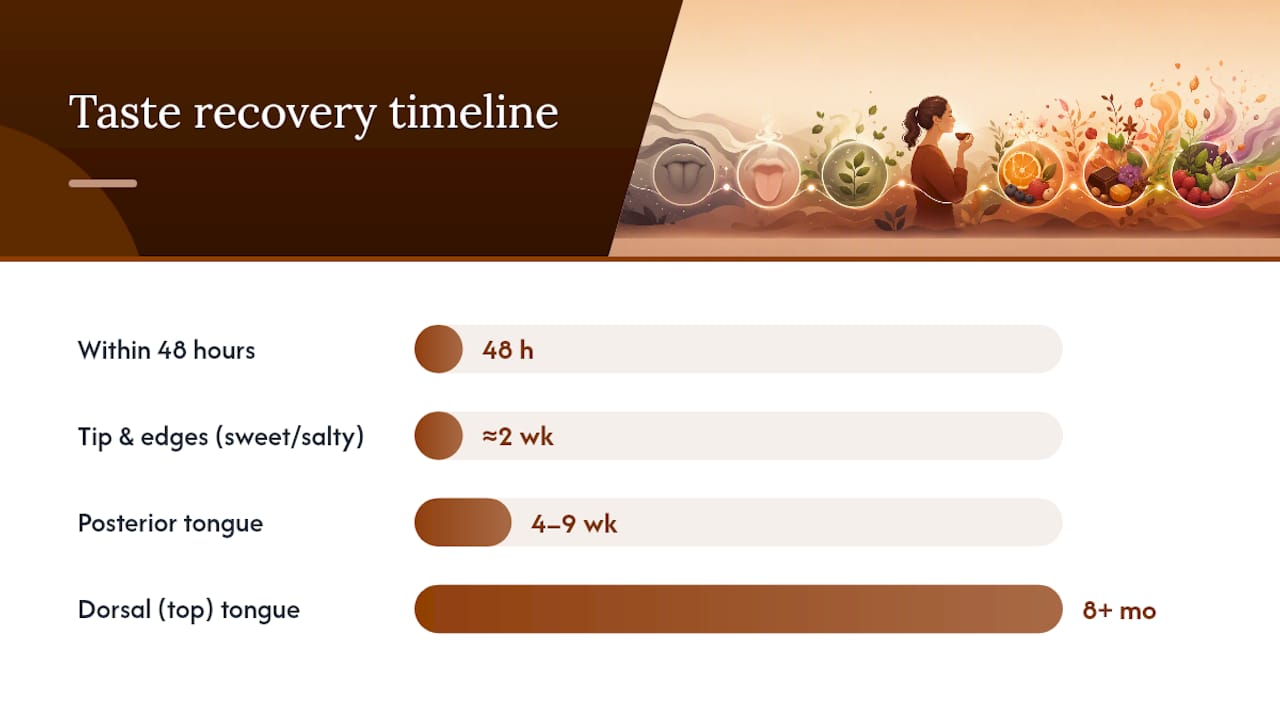
Between 4 and 9 weeks, taste at the back of the tongue typically catches up, and by nine weeks many participants in that same study reached near-normal sensitivity across most of the mouth. Other intervention research tracking taste thresholds after cessation found similar gains in this same window, which is a reassuring sign that the two-week mark isn’t a ceiling.
From 2 months out to 8 months or longer, the dorsal tongue, the top-center surface, is the slowest to bounce back. The same electrogustometry research on gustatory sensitivity after smoking cessation found some former smokers needed up to a year before this region matched nonsmoker thresholds.
By the numbers: Tip and edge taste sensitivity often recovers in about 2 weeks. Posterior tongue function catches up by 4 to 9 weeks. Dorsal tongue recovery can take 8 months or more in some people, according to electrogustometry recovery data.
What determines where you land on that range? A few things:
- How many years and how heavily you smoked (pack-years matter more than raw calendar time)
- How dependent you were, measured partly by how quickly you reached for a cigarette after waking
- Whether you have other conditions affecting taste, like sinus issues or dry mouth
- Individual variation in how fast taste cells regenerate, which differs person to person regardless of smoking history
Nobody heals on a fixed schedule. Think of the timeline as a range of plausible outcomes, not a countdown clock.
Why Does Smoking Change Taste and Smell in the First Place?
Cigarette smoke is hot, acidic, and full of chemical irritants, and taste buds sit right in its path every time you inhale. The heat alone damages the taste cells on your tongue’s surface, and because those cells normally regenerate every one to two weeks, chronic smoking keeps them in a permanent state of injury and incomplete repair.
Smell takes an even bigger hit, and smell is doing more work than most people realize. Most of what you register as “flavor” is actually retronasal smell, aroma traveling up from the back of the mouth to olfactory receptors in the nasal cavity. Smoke damages those receptors directly and also thickens the mucus layer that odor molecules need to cross to reach them. That’s a big part of why food can taste noticeably better within days of quitting: you’re not just regaining taste, you’re regaining smell, and the two combine to create most of what you experience as flavor.
Inflammation plays a supporting role too. Chronic smoke exposure keeps the lining of the mouth, throat, and nasal passages in a low-grade inflamed state, which further blunts sensory signaling until it settles down.
Recovery speed isn’t uniform across smokers, either. Research on smoking and taste function in U.S. adults found that people with higher pack-years and shorter time-to-first-cigarette (a marker of stronger dependence) tended to show larger taste deficits. Heavier, more dependent smoking history generally means a longer road back.
A few other factors can slow or complicate recovery regardless of smoking history:
- Certain medications (some blood pressure drugs and antibiotics dull taste as a side effect)
- Untreated dental disease, including gum infections and untreated cavities
- Chronic sinus problems or allergies that were masking taste issues all along
- Natural age-related decline in taste bud density, which happens to everyone over time
What Does It Actually Feel Like When Taste Comes Back?
Recovery rarely feels smooth. Most people describe a bumpy mix of sensations rather than a steady climb toward normal.
- Blandness that comes and goes. Some meals taste flat one day and vivid the next, which is normal fluctuation as different tongue regions heal at different speeds.
- A metallic or “off” taste. This shows up in the first week or two for a lot of quitters and usually fades as inflammation calms down and taste cells turn over.
- Sudden sweet cravings. As sensitivity to sweet flavors returns, sugary foods can taste more rewarding than they used to, which partly explains why so many new quitters reach for dessert.
- Foods tasting stronger than before. Spices, coffee, and strong cheeses sometimes feel almost overwhelming for a few weeks as sensitivity rebounds faster than your brain adjusts to it.
These sensations map loosely onto the timeline above. Metallic taste and blandness are more common early, in the first two to four weeks, while heightened sensitivity to sweet and savory foods tends to show up as recovery progresses.
Pro Tip: Keep a glass of plain water nearby during meals in the first few weeks. A sip between bites resets your palate and makes it easier to notice real changes instead of lingering aftertastes from the last thing you ate.
Quick fixes that help in the moment: a citrus rinse (water with a splash of lemon juice) can cut through a metallic taste fast, cold foods often taste cleaner than hot ones when your palate feels off, and contrasting textures, crunchy against smooth, can jolt sluggish taste buds back into paying attention.
Most of this is temporary. If a strange taste sticks around unchanged for months rather than shifting week to week, that’s a different situation, covered further down.
How Can You Support Your Taste Recovery After Quitting?
You can’t force taste cells to regenerate faster, but you can absolutely stop working against them and give recovery the best possible conditions.
Start with your mouth: explore smoking-related products and cessation support that can help you on your journey. Oral hygiene has a bigger effect on taste than most people expect, because bacteria, plaque, and dry mouth all interfere with how taste molecules reach your receptors.
- Scrape your tongue every morning, not just brush it. Buildup on the tongue’s surface muffles taste more than most people realize.
- Floss daily. Gum inflammation from trapped food debris measurably dulls taste sensitivity.
- Treat dry mouth. Reduced saliva flow, common in the weeks after quitting, makes it harder for flavor compounds to dissolve and reach your taste buds. Sugar-free lozenges or a humidifier at night can help.
- See a dentist if you’ve been putting it off. Untreated dental disease is one of the most overlooked causes of long-term taste dulling.
Reintroduce flavor deliberately instead of all at once. Jumping straight to strongly spiced or heavily processed foods can overwhelm a palate that’s mid-recovery.
- Start mild and build up. Simple roasted vegetables or grilled chicken let you notice subtle changes without competing flavors drowning them out.
- Lean on aromatics like fresh basil, garlic, or ginger. These stimulate smell as much as taste, which speeds up how quickly food starts tasting like something again.
- Play with temperature contrast, a warm dish with a cold garnish, since contrast wakes up sluggish receptors faster than any single flavor alone.
- Eat slower and pay attention. Mindful eating, a practice Smokefree recommends for people adjusting to post-quit appetite changes, helps you actually register the changes happening rather than eating on autopilot.
Protect your nutrition while your palate recalibrates. This is where a lot of quit attempts go sideways, not from craving cigarettes but from craving snack food.
- Build meals around protein first. It’s more filling and less likely to trigger the sugar chase that comes with heightened sweet-taste sensitivity.
- Prep low-calorie snacks in advance (cut vegetables, portioned nuts) so a taste-driven craving doesn’t automatically become a trip to the vending machine.
- Watch out for “replacement” foods, chips, candy, soda, that quietly become a new oral habit standing in for cigarettes.
- Use portion control tools like smaller plates or pre-portioned containers rather than relying on willpower alone.
Give your hands and mouth something else to do. A lot of “snacking” after quitting isn’t really about hunger. It’s the same hand-to-mouth ritual that a cigarette used to satisfy, now looking for a new outlet. Swapping that ritual for a non-food object, a pen to click, a toothpick, or a dedicated oral-fixation tool, breaks the automatic link between boredom or stress and reaching for something to chew.
Pro Tip: When a craving hits and you can’t tell if it’s hunger or habit, wait five minutes and drink a full glass of water first. If the urge fades, it usually wasn’t hunger.
Simple behavioral scripts also help. A basic if-then plan (if I feel the urge to snack after dinner, then I’ll take a ten-minute walk instead) removes the decision-making moment where most slips happen.
Why Does Appetite and Weight Change After Quitting?
Nicotine isn’t just an appetite suppressant. It measurably speeds up your metabolism, and losing that effect is part of why the scale often creeps up after quitting, not a sign of anything going wrong.
Nicotine raises resting metabolic rate by roughly 7 to 15 percent, according to MedlinePlus, which explains why quitting is linked to an average weight gain of about 5 to 10 pounds in the months that follow. That’s a real, measurable shift, not just a matter of eating more.
Taste recovery compounds it. As smell and taste sharpen, Smokefree notes that food often becomes more enjoyable, and that heightened enjoyment tends to skew toward sweet and fatty foods rather than vegetables, simply because those flavors are more rewarding to a recovering palate.
- Increase protein at every meal to blunt the sugar pull and stay fuller longer.
- Plan snacks ahead rather than deciding in the moment, when cravings are loudest.
- Swap an after-dinner drink or dessert ritual for a walk, which handles the habit slot without adding calories.
- Focus on replacing the behavior of smoking rather than restricting food, which tends to backfire and increase stress eating.
Here’s the perspective worth holding onto: a modest weight gain is a far smaller health risk than continuing to smoke, a point Better Health Channel makes explicitly when weighing the two outcomes against each other. If weight gain exceeds 10 to 15 pounds or starts affecting your health, a registered dietitian or your doctor can help you build a plan that doesn’t put your quit attempt at risk.
When Should You See a Doctor About Taste Changes?
Most taste disruption after quitting resolves on its own within the timelines above. A smaller number of cases point to something else going on and deserve a real evaluation.
- No improvement at all after several months of consistent nonsmoking
- Taste getting progressively worse instead of better over time
- Sudden, total loss of taste rather than a gradual dulling
- Neurological signs alongside the taste change: persistent headache, facial weakness, or numbness
- Ongoing loss of smell that doesn’t track with the taste pattern described earlier
A workup for persistent dysgeusia (the clinical term for distorted or reduced taste) usually starts with a medication review, since several common drugs affect taste as a side effect. From there, an ENT evaluation, formal smell and taste testing, or imaging may follow depending on what the initial exam turns up.
When you talk to a clinician, come prepared with three things: exactly when the taste change started relative to your quit date, your smoking history (roughly how many years and how much per day), and a full list of current medications. That context speeds up diagnosis considerably.
What I’ve Learned About Taste Recovery and Staying Quit
The pattern I keep coming back to is this: taste recovery isn’t just a side effect of quitting, it’s one of the best tools you have for staying quit. People who notice food tasting better tend to describe it as proof that something is actually working, at a point in the process when motivation often sags.
That’s worth using deliberately, not just waiting for. Keep a simple note on your phone of what’s tasting different and when, coffee, a favorite meal, whatever you eat most often. A concrete log turns something abstract into evidence you can point to on a hard day.
Something I’d push back on: a lot of quit advice treats appetite changes as a problem to white-knuckle through. I think that’s backwards. The urge to put something in your mouth after a meal, or during a stressful afternoon, isn’t a character flaw. It’s a habit loop that took years to build, and it deserves a real replacement, not just suppression.
— Tommy
A Non-Nicotine Tool for the Habit That Outlasts the Craving
Taste recovery solves the flavor problem. It doesn’t solve the habit of reaching for something with your hands or mouth every time stress or boredom hits, which is exactly the gap Breathefree was built to fill. Instead of a cigarette, a snack, or nothing at all, you get a solid, plant-fiber based object designed for the same oral fixation and hand ritual smoking used to satisfy, with zero nicotine and zero inhalation involved.
The BreatheFree Resistance Necklace works alongside the flavor-recovery strategies above rather than replacing them. On days when a craving hits before your palate has fully adjusted, having something to hold and use instead of opening the pantry can be the difference between a slip and a save. Breathefree also sells flavor refills so the sensory experience stays fresh over time, backed by a 30-day money-back guarantee and a community of people going through the same recovery window you are.
This is a support tool, not a medical treatment, and it won’t fix a genuine taste disorder. If your symptoms match the red flags above, see a clinician first. For everyday cravings and the habit loop that outlasts the first few smoke-free weeks, take a look at the necklace and refill collection and see if it fits your routine.
This article is general information, not a substitute for advice from a qualified doctor. Consult a qualified healthcare professional about your own circumstances before acting on anything here.
Sources
- Effect of cigarette smoke on gustatory sensitivity, evaluation of the deficit and of the recovery time-course after smoking cessation
- Quitting smoking: What to expect (MedlinePlus patient education)
- Nutrition & appetite while quitting | Smokefree
FAQ
How Long Before Taste Buds Come Back After Quitting Smoking?
Tip and edge taste sensitivity often recovers within about 2 weeks, while posterior tongue function typically catches up by 4 to 9 weeks. Some regions, particularly the top-center of the tongue, can take 8 months or longer to fully normalize, especially for people with a longer or heavier smoking history.
What Can I Eat to Get My Taste Back?
No specific food speeds up taste recovery, but mild, aromatic foods, think fresh herbs, citrus, and roasted vegetables, help you notice improvement more clearly than heavily processed or overly spiced meals. Staying hydrated and treating dry mouth also matter, since saliva helps carry flavor molecules to your taste buds.
Why Can’t I Taste Anything, But I Don’t Have COVID?
Reduced taste after quitting smoking is usually tied to lingering nerve and receptor damage from years of smoke exposure, not an infection. If it’s been more than a few months with no improvement, or if it’s paired with severe smell loss or neurological symptoms, see a doctor to rule out other causes like medication side effects or sinus issues.
What Do You Do When Your Taste Buds Feel Off?
Try a citrus water rinse to cut through metallic or dull tastes, and lean on cold or crunchy foods, which tend to register more clearly than warm, soft ones. Give it time. Fluctuating taste in the first few weeks after quitting is normal and usually settles as recovery progresses.